 Image 1 of 1
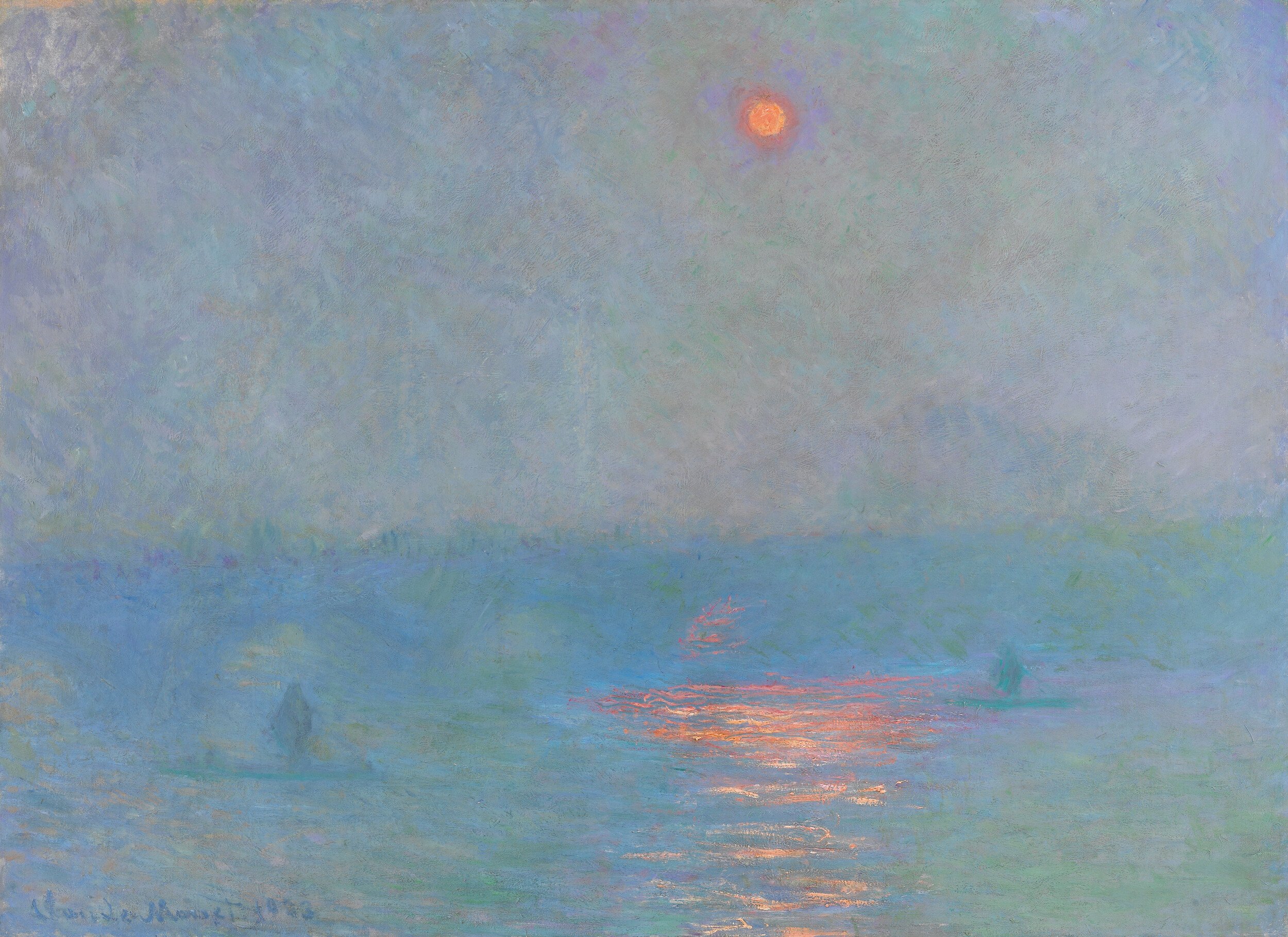
“Waterloo Bridge: Sun in a Fog” — Claude Monet
“Waterloo Bridge: Sun in a Fog” belongs to Monet’s London series, where the city becomes less a fixed view than an atmosphere of light, haze, and reflection. Monet returned to Waterloo Bridge repeatedly, using fog, light, and shifting atmosphere to transform the same subject again and again.
The composition is spare and luminous. Small boats and the faint structure of the bridge emerge through a veil of mist, while the low sun spreads orange and pink through the sky and across the water. The image is built less from hard outline than from shifting color, allowing river, haze, and evening light to merge into one continuous surface. The result feels both industrial and fleeting, with the city nearly dissolving into atmosphere.
Claude Monet is best known for turning light and changing perception into the true subjects of painting. In the London pictures especially, he treated fog not as an obstacle to vision, but as the very condition that made the scene visually alive.
Expressed on silk and paired with integrated illumination, the artwork takes on a different presence from traditional surfaces. The translucency of silk allows light to pass through the image, introducing a sense of depth and softness that changes with its surroundings. Rather than remaining a fixed image, the piece responds to light and its environment, shifting in presence throughout the day. Appearing quiet and refined in natural light, it becomes softly luminous as light grows more prominent.
“Waterloo Bridge: Sun in a Fog” — Claude Monet
“Waterloo Bridge: Sun in a Fog” belongs to Monet’s London series, where the city becomes less a fixed view than an atmosphere of light, haze, and reflection. Monet returned to Waterloo Bridge repeatedly, using fog, light, and shifting atmosphere to transform the same subject again and again.
The composition is spare and luminous. Small boats and the faint structure of the bridge emerge through a veil of mist, while the low sun spreads orange and pink through the sky and across the water. The image is built less from hard outline than from shifting color, allowing river, haze, and evening light to merge into one continuous surface. The result feels both industrial and fleeting, with the city nearly dissolving into atmosphere.
Claude Monet is best known for turning light and changing perception into the true subjects of painting. In the London pictures especially, he treated fog not as an obstacle to vision, but as the very condition that made the scene visually alive.
Expressed on silk and paired with integrated illumination, the artwork takes on a different presence from traditional surfaces. The translucency of silk allows light to pass through the image, introducing a sense of depth and softness that changes with its surroundings. Rather than remaining a fixed image, the piece responds to light and its environment, shifting in presence throughout the day. Appearing quiet and refined in natural light, it becomes softly luminous as light grows more prominent.