 Image 1 of 1
“Waterlilies Pond, Green Reflection” — Claude Monet
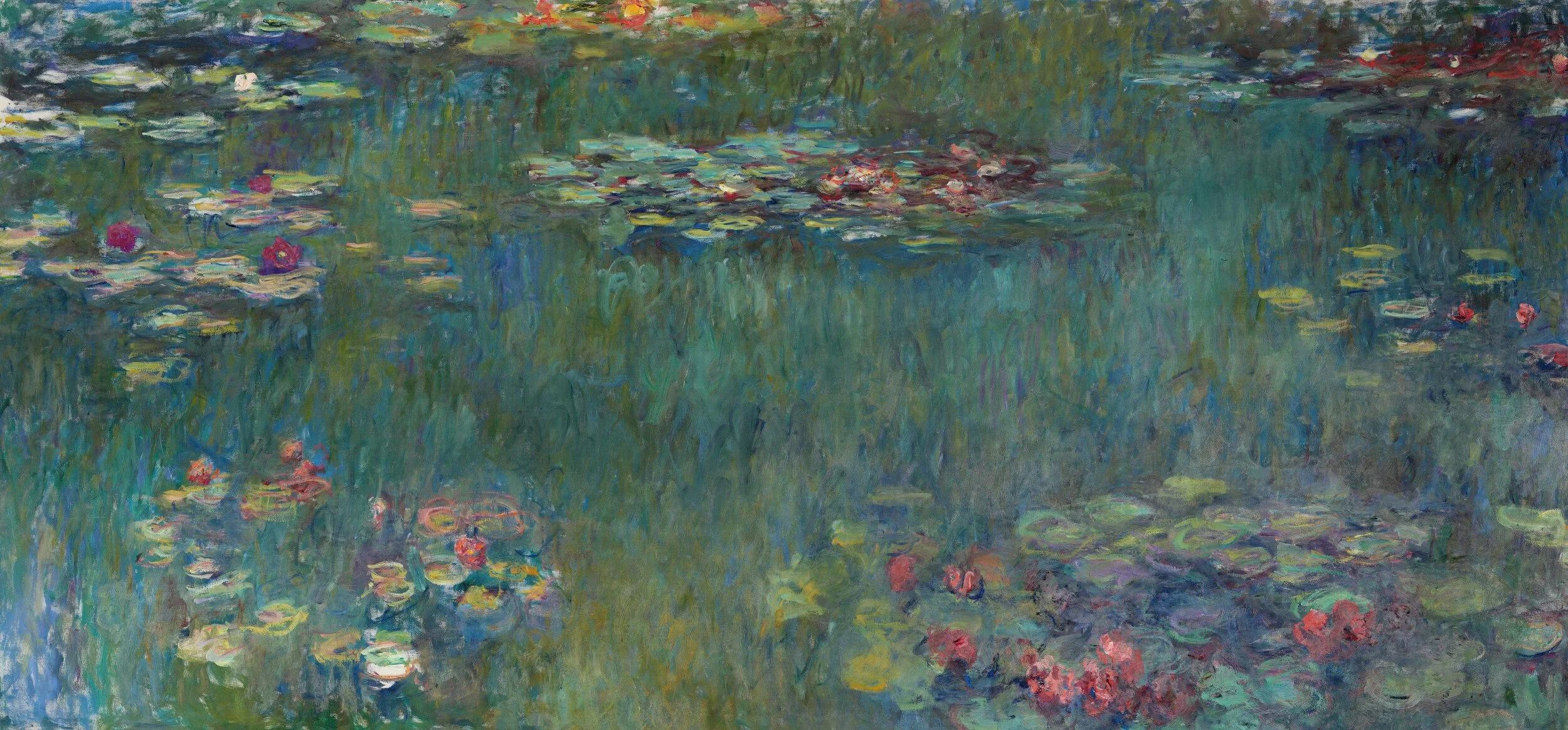
“Waterlilies Pond, Green Reflection” presents the surface of the pond as a field of shifting color, reflection, and floating blossoms. Rather than organizing the scene around a horizon or a fixed point of depth, the painting immerses the viewer in water itself, where lilies, reflected foliage, and subtle movement dissolve into one another.
The artwork is spread across the water’s surface, with clusters of lilies and pink blossoms gathering in loose bands while green reflections descend through the pond like veils. The image feels both open and intimate at once. Instead of guiding the eye through a conventional landscape, Monet lets color, texture, and reflected light create a slow, continuous rhythm across the canvas.
Claude Monet devoted decades of his later career to the water-lily pond at Giverny, making it the central subject of one of the most important series in modern painting. The Water Lilies collection grew from the late 1890s through the end of his life, and these works increasingly turned away from traditional spatial structure in favor of atmosphere, surface, and changing light.
Expressed on silk and paired with integrated illumination, the artwork takes on a different presence from traditional surfaces. The translucency of silk allows light to pass through the image, introducing a sense of depth and softness that changes with its surroundings. Rather than remaining a fixed image, the piece responds to light and its environment, shifting in presence throughout the day. Appearing quiet and refined in natural light, it becomes softly luminous as light grows more prominent.
“Waterlilies Pond, Green Reflection” — Claude Monet
“Waterlilies Pond, Green Reflection” presents the surface of the pond as a field of shifting color, reflection, and floating blossoms. Rather than organizing the scene around a horizon or a fixed point of depth, the painting immerses the viewer in water itself, where lilies, reflected foliage, and subtle movement dissolve into one another.
The artwork is spread across the water’s surface, with clusters of lilies and pink blossoms gathering in loose bands while green reflections descend through the pond like veils. The image feels both open and intimate at once. Instead of guiding the eye through a conventional landscape, Monet lets color, texture, and reflected light create a slow, continuous rhythm across the canvas.
Claude Monet devoted decades of his later career to the water-lily pond at Giverny, making it the central subject of one of the most important series in modern painting. The Water Lilies collection grew from the late 1890s through the end of his life, and these works increasingly turned away from traditional spatial structure in favor of atmosphere, surface, and changing light.
Expressed on silk and paired with integrated illumination, the artwork takes on a different presence from traditional surfaces. The translucency of silk allows light to pass through the image, introducing a sense of depth and softness that changes with its surroundings. Rather than remaining a fixed image, the piece responds to light and its environment, shifting in presence throughout the day. Appearing quiet and refined in natural light, it becomes softly luminous as light grows more prominent.