 Image 1 of 1
“Water Lilies” — Claude Monet
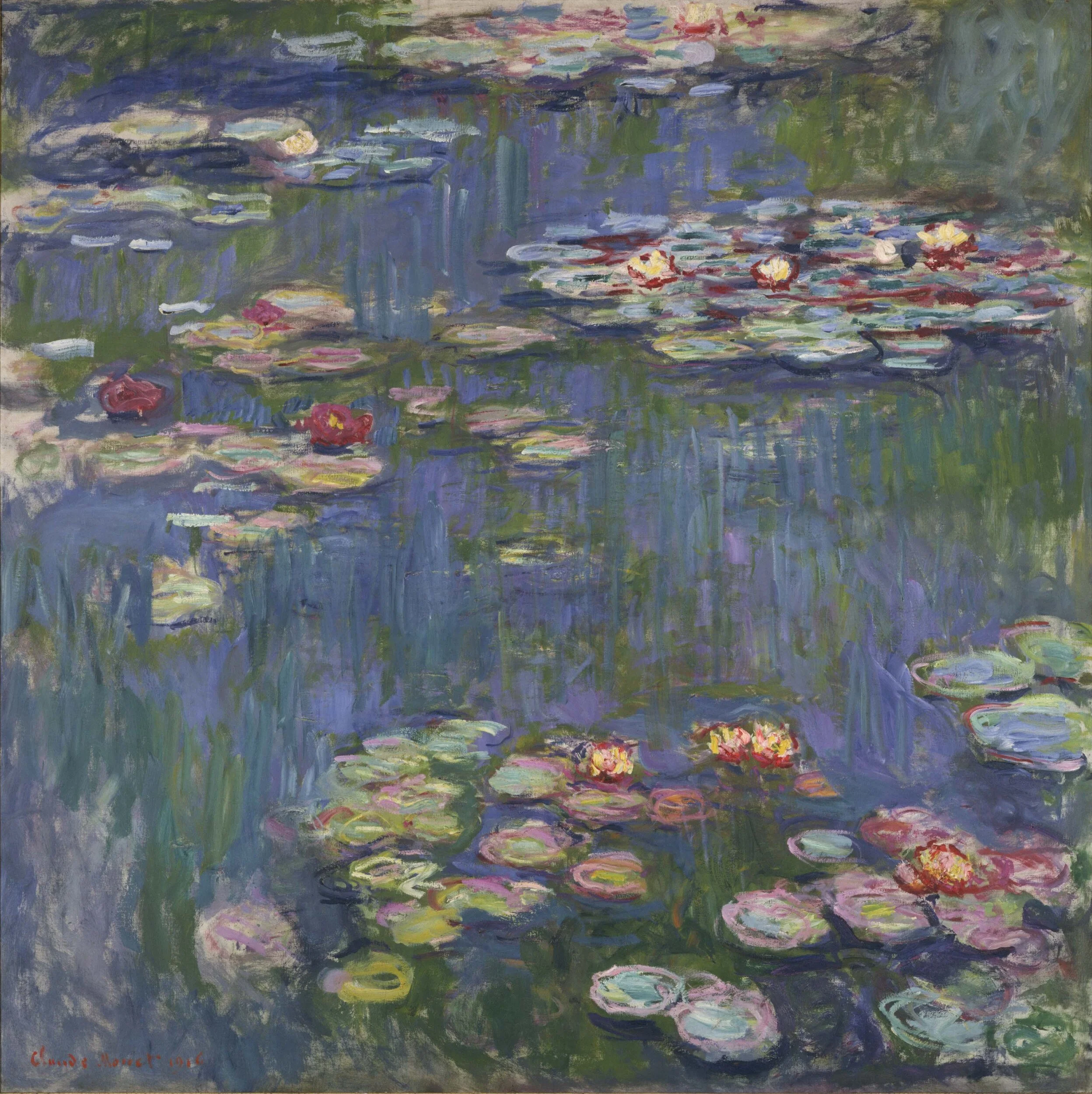
“Water Lilies” presents the surface of Monet’s pond as a world of shifting color, reflection, and floating forms. Rather than giving the viewer a fixed horizon or clear boundary, the painting draws attention to water itself, where lilies, reflected greenery, and patches of blue seem to move gently across the surface. The result is calm but active, turning a quiet garden subject into an immersive study of light and perception.
Lily pads and blossoms gather in loose clusters across the water, creating a gentle rhythm through the composition. Cool blues and greens dominate the surface, while small touches of red, pink, yellow, and white bring warmth and movement into the pond. The painting gives the impression of water, flowers, and reflected foliage blending into one continuous field of color.
Monet returned to the water lilies at Giverny for many years, using the pond as a setting for exploring changing light, atmosphere, and reflection. By the time this work was painted, he had been studying the subject for nearly two decades, allowing the garden to become less a view of nature than a living field of color and sensation.
Expressed on silk and paired with integrated illumination, the artwork takes on a different presence from traditional surfaces. The translucency of silk allows light to pass through the image, introducing a sense of depth and softness that changes with its surroundings. Rather than remaining a fixed image, the piece responds to light and its environment, shifting in presence throughout the day. Appearing quiet and refined in natural light, it becomes softly luminous as light grows more prominent.
“Water Lilies” — Claude Monet
“Water Lilies” presents the surface of Monet’s pond as a world of shifting color, reflection, and floating forms. Rather than giving the viewer a fixed horizon or clear boundary, the painting draws attention to water itself, where lilies, reflected greenery, and patches of blue seem to move gently across the surface. The result is calm but active, turning a quiet garden subject into an immersive study of light and perception.
Lily pads and blossoms gather in loose clusters across the water, creating a gentle rhythm through the composition. Cool blues and greens dominate the surface, while small touches of red, pink, yellow, and white bring warmth and movement into the pond. The painting gives the impression of water, flowers, and reflected foliage blending into one continuous field of color.
Monet returned to the water lilies at Giverny for many years, using the pond as a setting for exploring changing light, atmosphere, and reflection. By the time this work was painted, he had been studying the subject for nearly two decades, allowing the garden to become less a view of nature than a living field of color and sensation.
Expressed on silk and paired with integrated illumination, the artwork takes on a different presence from traditional surfaces. The translucency of silk allows light to pass through the image, introducing a sense of depth and softness that changes with its surroundings. Rather than remaining a fixed image, the piece responds to light and its environment, shifting in presence throughout the day. Appearing quiet and refined in natural light, it becomes softly luminous as light grows more prominent.