 Image 1 of 1
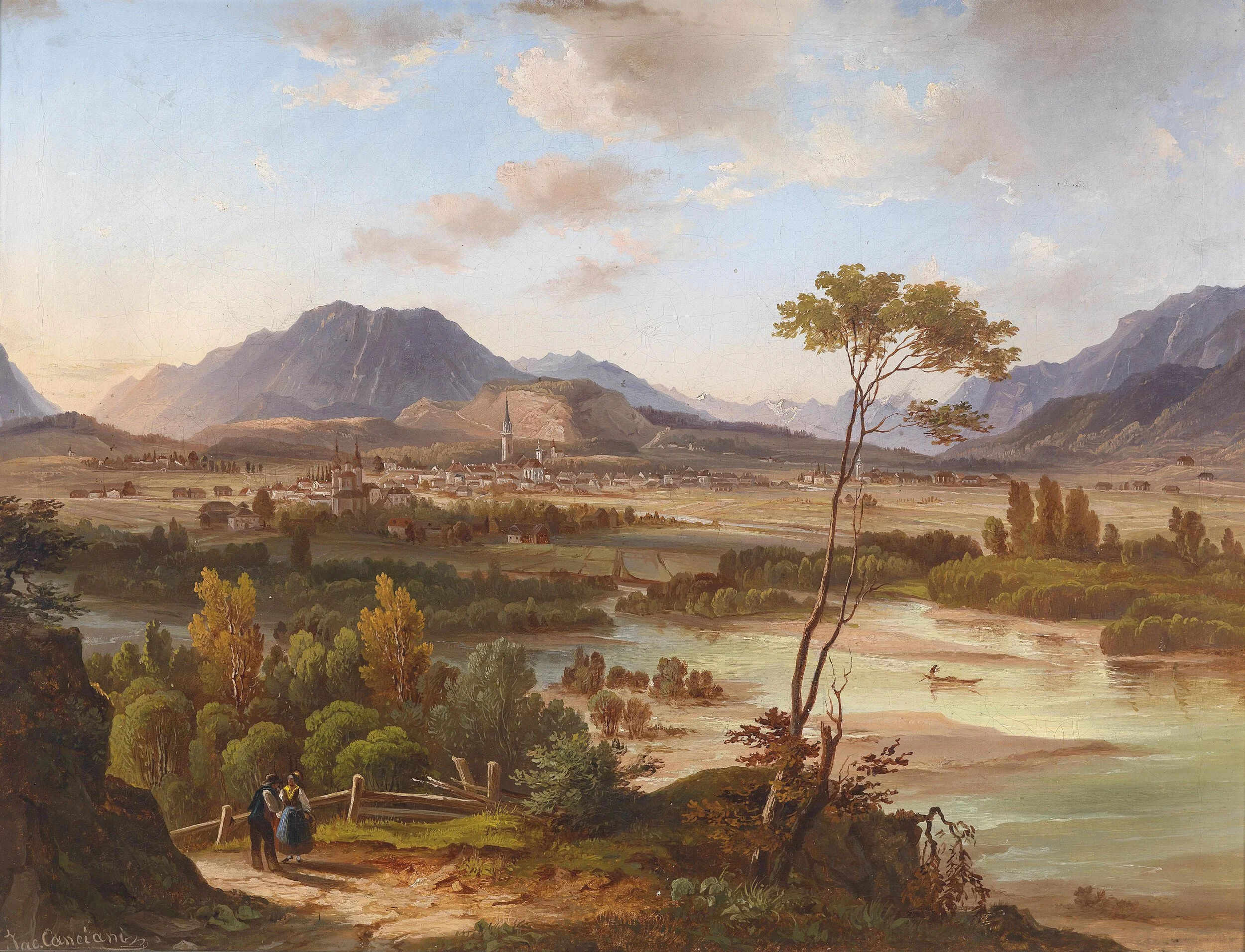
“View of Villach” — Jakob Canciani
“View of Villach” presents the Austrian town as part of a larger alpine landscape, balancing settlement, river plain, and distant mountains in one wide, ordered view. Rather than isolating the town as an architectural subject, the painting places it within its natural setting, where open land, water, and mountain ranges give the scene both scale and calm.
The composition opens from an elevated foreground, where a path and small figures lead the eye toward the town below. Beyond the clustered buildings and church towers, fields and waterways spread across the valley before giving way to a ring of mountains. The painting feels expansive but controlled, combining careful topographical clarity with a quiet atmospheric distance.
Jakob Canciani was a 19th-century painter associated with landscape and regional views in Carinthia. Works like this suggest a strong interest in place, where geography and inhabited landscape are held together in a balanced, panoramic structure.
Expressed on silk and paired with integrated illumination, the artwork takes on a different presence from traditional surfaces. The translucency of silk allows light to pass through the image, introducing a sense of depth and softness that changes with its surroundings. Rather than remaining a fixed image, the piece responds to light and its environment, shifting in presence throughout the day. Appearing quiet and refined in natural light, it becomes softly luminous as light grows more prominent.
“View of Villach” — Jakob Canciani
“View of Villach” presents the Austrian town as part of a larger alpine landscape, balancing settlement, river plain, and distant mountains in one wide, ordered view. Rather than isolating the town as an architectural subject, the painting places it within its natural setting, where open land, water, and mountain ranges give the scene both scale and calm.
The composition opens from an elevated foreground, where a path and small figures lead the eye toward the town below. Beyond the clustered buildings and church towers, fields and waterways spread across the valley before giving way to a ring of mountains. The painting feels expansive but controlled, combining careful topographical clarity with a quiet atmospheric distance.
Jakob Canciani was a 19th-century painter associated with landscape and regional views in Carinthia. Works like this suggest a strong interest in place, where geography and inhabited landscape are held together in a balanced, panoramic structure.
Expressed on silk and paired with integrated illumination, the artwork takes on a different presence from traditional surfaces. The translucency of silk allows light to pass through the image, introducing a sense of depth and softness that changes with its surroundings. Rather than remaining a fixed image, the piece responds to light and its environment, shifting in presence throughout the day. Appearing quiet and refined in natural light, it becomes softly luminous as light grows more prominent.