 Image 1 of 1
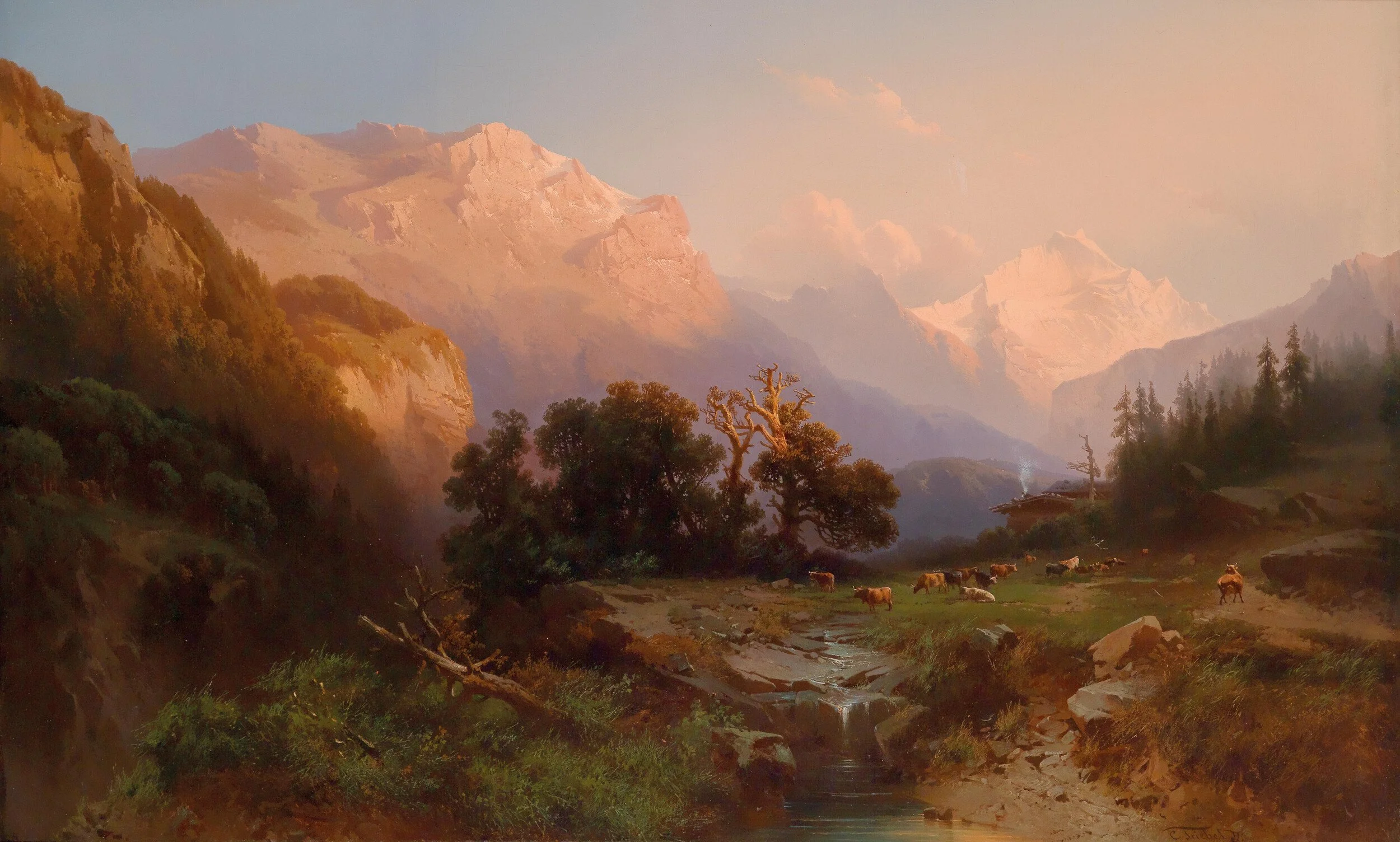
“View of Großglockner in Evening Light” — Carl Triebel
Set in the quiet warmth of evening, “View of Großglockner in Evening Light” captures the transition between day and night across one of the Alps’ most dramatic mountain regions. The scene balances the vast scale of distant peaks with the calm presence of everyday life below.
In the foreground, a narrow stream cuts through a grassy clearing where cattle graze near a small cabin. Trees and rocky ground frame the space, while the land gradually recedes toward towering mountains in the distance. The peaks rise sharply, their upper slopes covered in snow and ice, catching the last light of the day. The contrast between the grounded foreground and the expansive background gives the composition both intimacy and grandeur.
Carl Triebel was a nineteenth-century German landscape painter known for views of mountainous regions and natural settings. His work often reflects a careful attention to atmosphere and light, placing human-scale activity within broader natural environments.
Expressed on silk and paired with integrated illumination, the artwork takes on a different presence from traditional surfaces. The translucency of silk allows light to pass through the image, introducing a sense of depth and softness that changes with its surroundings. Rather than remaining a fixed image, the piece responds to light and its environment, shifting in presence throughout the day. Appearing quiet and refined in natural light, it becomes softly luminous as light grows more prominent.
“View of Großglockner in Evening Light” — Carl Triebel
Set in the quiet warmth of evening, “View of Großglockner in Evening Light” captures the transition between day and night across one of the Alps’ most dramatic mountain regions. The scene balances the vast scale of distant peaks with the calm presence of everyday life below.
In the foreground, a narrow stream cuts through a grassy clearing where cattle graze near a small cabin. Trees and rocky ground frame the space, while the land gradually recedes toward towering mountains in the distance. The peaks rise sharply, their upper slopes covered in snow and ice, catching the last light of the day. The contrast between the grounded foreground and the expansive background gives the composition both intimacy and grandeur.
Carl Triebel was a nineteenth-century German landscape painter known for views of mountainous regions and natural settings. His work often reflects a careful attention to atmosphere and light, placing human-scale activity within broader natural environments.
Expressed on silk and paired with integrated illumination, the artwork takes on a different presence from traditional surfaces. The translucency of silk allows light to pass through the image, introducing a sense of depth and softness that changes with its surroundings. Rather than remaining a fixed image, the piece responds to light and its environment, shifting in presence throughout the day. Appearing quiet and refined in natural light, it becomes softly luminous as light grows more prominent.