 Image 1 of 1
“View of Devin Castle Ruins” — Josef Holzer
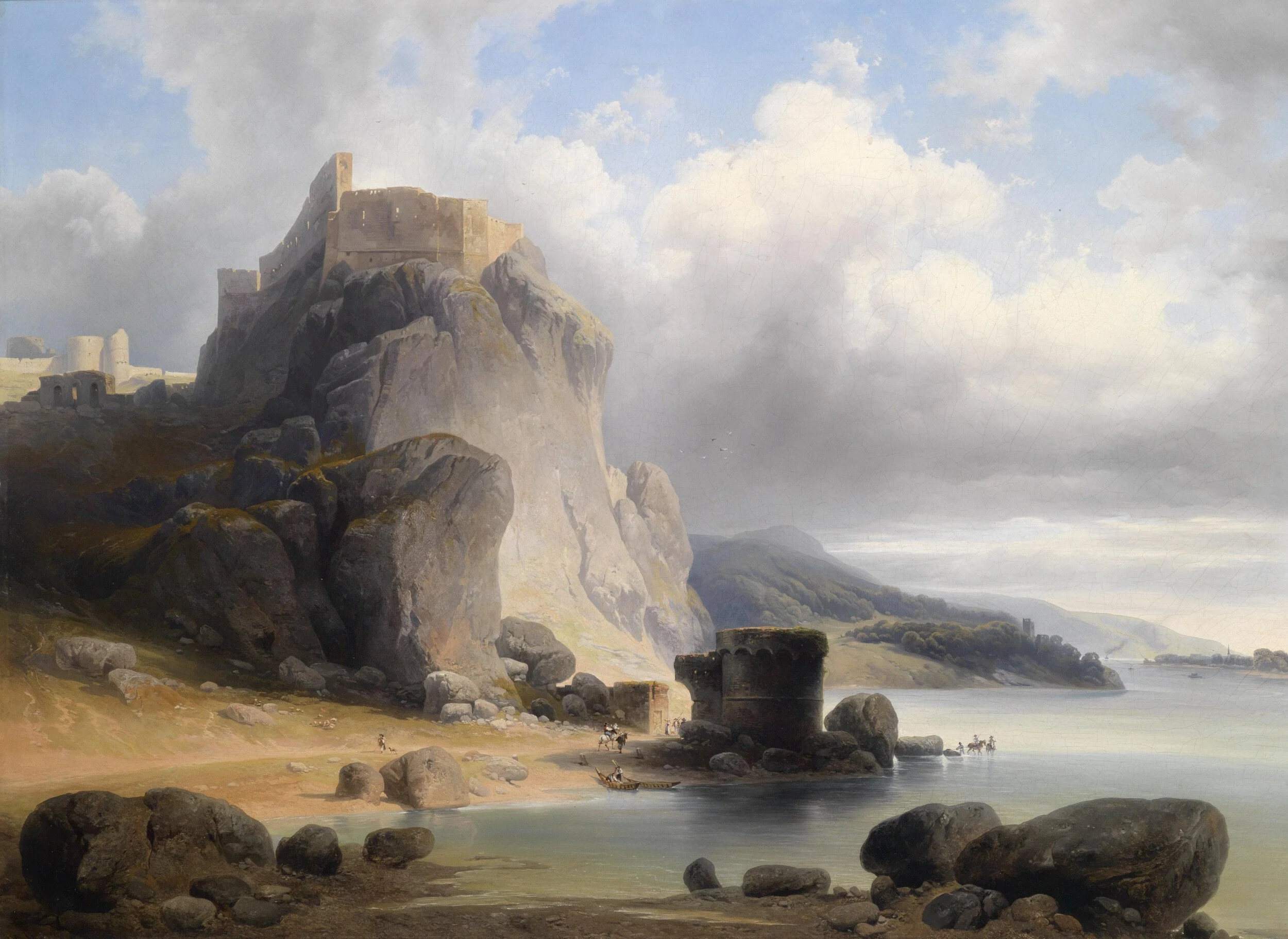
“View of Devin Castle Ruins” presents a rocky riverside stronghold through broad light, open sky, and a carefully balanced relationship between architecture and landscape. Rather than isolating the ruins as a purely historical subject, the painting places them within a larger natural setting of water, stone, and distance, giving the scene both monumentality and calm.
The composition is anchored by the towering cliff and fortress at the left, which rise sharply above the shoreline. Below them, small figures, boats, and scattered structures bring the scene down to a human scale, while the river opens quietly toward the distance on the right. The painting feels expansive but orderly, with the massive rock face holding the entire landscape together.
Josef Holzer was an Austrian painter associated with landscape views, and in works like this he combines topographical clarity with a measured atmospheric calm. The result is not simply descriptive. It allows geography, ruins, and lived activity to coexist within one unified scene.
Expressed on silk and paired with integrated illumination, the artwork takes on a different presence from traditional surfaces. The translucency of silk allows light to pass through the image, introducing a sense of depth and softness that changes with its surroundings. Rather than remaining a fixed image, the piece responds to light and its environment, shifting in presence throughout the day. Appearing quiet and refined in natural light, it becomes softly luminous as light grows more prominent.
“View of Devin Castle Ruins” — Josef Holzer
“View of Devin Castle Ruins” presents a rocky riverside stronghold through broad light, open sky, and a carefully balanced relationship between architecture and landscape. Rather than isolating the ruins as a purely historical subject, the painting places them within a larger natural setting of water, stone, and distance, giving the scene both monumentality and calm.
The composition is anchored by the towering cliff and fortress at the left, which rise sharply above the shoreline. Below them, small figures, boats, and scattered structures bring the scene down to a human scale, while the river opens quietly toward the distance on the right. The painting feels expansive but orderly, with the massive rock face holding the entire landscape together.
Josef Holzer was an Austrian painter associated with landscape views, and in works like this he combines topographical clarity with a measured atmospheric calm. The result is not simply descriptive. It allows geography, ruins, and lived activity to coexist within one unified scene.
Expressed on silk and paired with integrated illumination, the artwork takes on a different presence from traditional surfaces. The translucency of silk allows light to pass through the image, introducing a sense of depth and softness that changes with its surroundings. Rather than remaining a fixed image, the piece responds to light and its environment, shifting in presence throughout the day. Appearing quiet and refined in natural light, it becomes softly luminous as light grows more prominent.