 Image 1 of 1
“Van Tromp Going About to Please His Masters” — Joseph Mallord William Turner
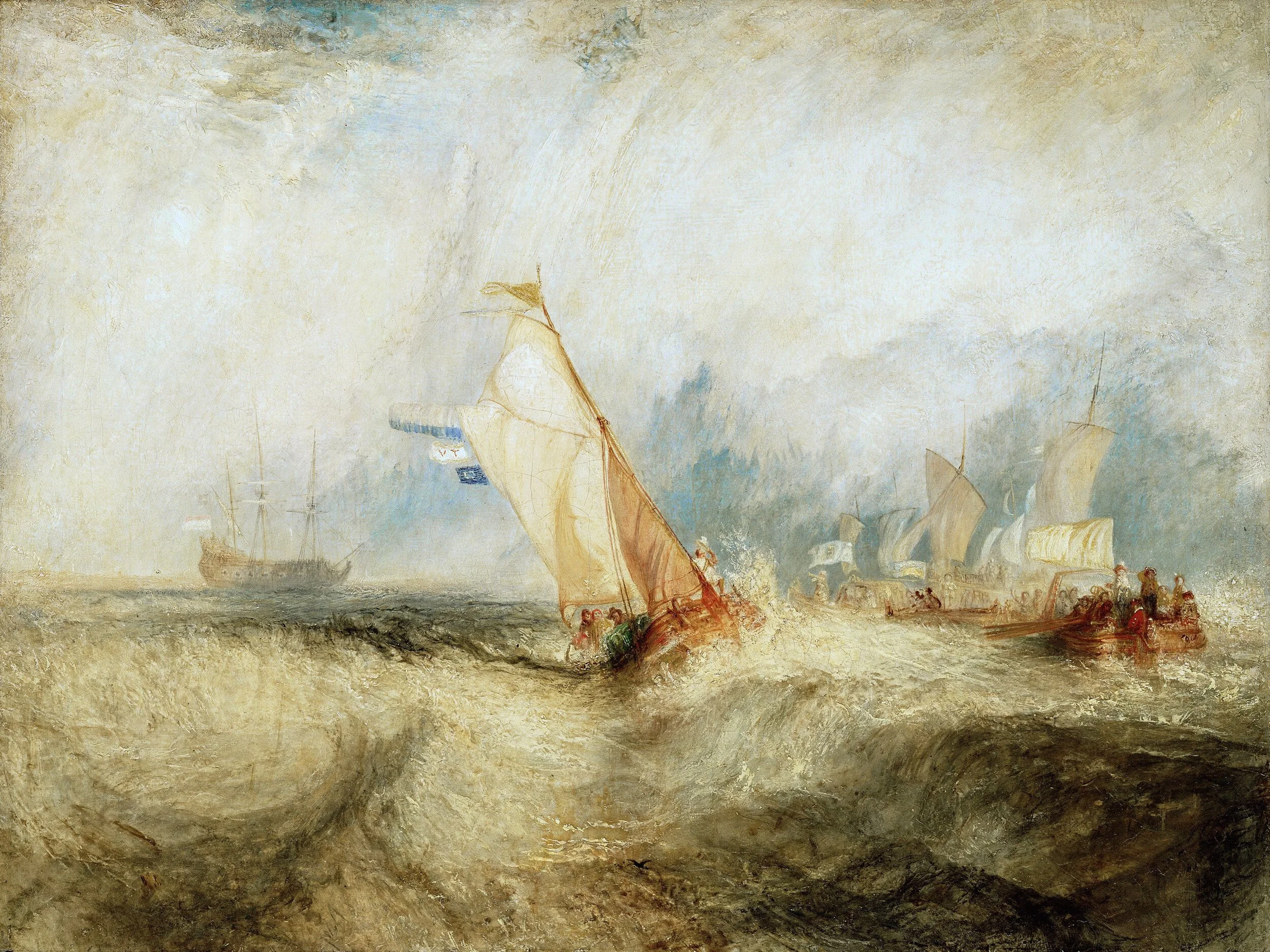
“Van Tromp Going About to Please His Masters” is one of Turner’s most energetic marine paintings, built around wind, spray, and the unstable motion of ships in rough water. The title refers to a Dutch admiral, but the force of the painting lies less in historical detail than in the drama of weather and maneuver.
The composition is crowded but controlled. A sharply tilted vessel surges in the foreground, its sail catching the light as waves break around it. Behind it, other ships and boats press through the scene, giving the painting a sense of active command rather than passive observation. The sea is not just a setting here. It is the field of action itself, shaping every movement across the canvas.
Turner’s marine pictures helped establish his reputation early and remained central throughout his career. In paintings like this, he joins historical reference with atmosphere and motion, turning naval action into a spectacle of light and weather.
Expressed on silk and paired with integrated illumination, the artwork takes on a different presence from traditional surfaces. The translucency of silk allows light to pass through the image, introducing a sense of depth and softness that changes with its surroundings. Rather than remaining a fixed image, the piece responds to light and its environment, shifting in presence throughout the day. Appearing quiet and refined in natural light, it becomes softly luminous as light grows more prominent.
“Van Tromp Going About to Please His Masters” — Joseph Mallord William Turner
“Van Tromp Going About to Please His Masters” is one of Turner’s most energetic marine paintings, built around wind, spray, and the unstable motion of ships in rough water. The title refers to a Dutch admiral, but the force of the painting lies less in historical detail than in the drama of weather and maneuver.
The composition is crowded but controlled. A sharply tilted vessel surges in the foreground, its sail catching the light as waves break around it. Behind it, other ships and boats press through the scene, giving the painting a sense of active command rather than passive observation. The sea is not just a setting here. It is the field of action itself, shaping every movement across the canvas.
Turner’s marine pictures helped establish his reputation early and remained central throughout his career. In paintings like this, he joins historical reference with atmosphere and motion, turning naval action into a spectacle of light and weather.
Expressed on silk and paired with integrated illumination, the artwork takes on a different presence from traditional surfaces. The translucency of silk allows light to pass through the image, introducing a sense of depth and softness that changes with its surroundings. Rather than remaining a fixed image, the piece responds to light and its environment, shifting in presence throughout the day. Appearing quiet and refined in natural light, it becomes softly luminous as light grows more prominent.