 Image 1 of 1
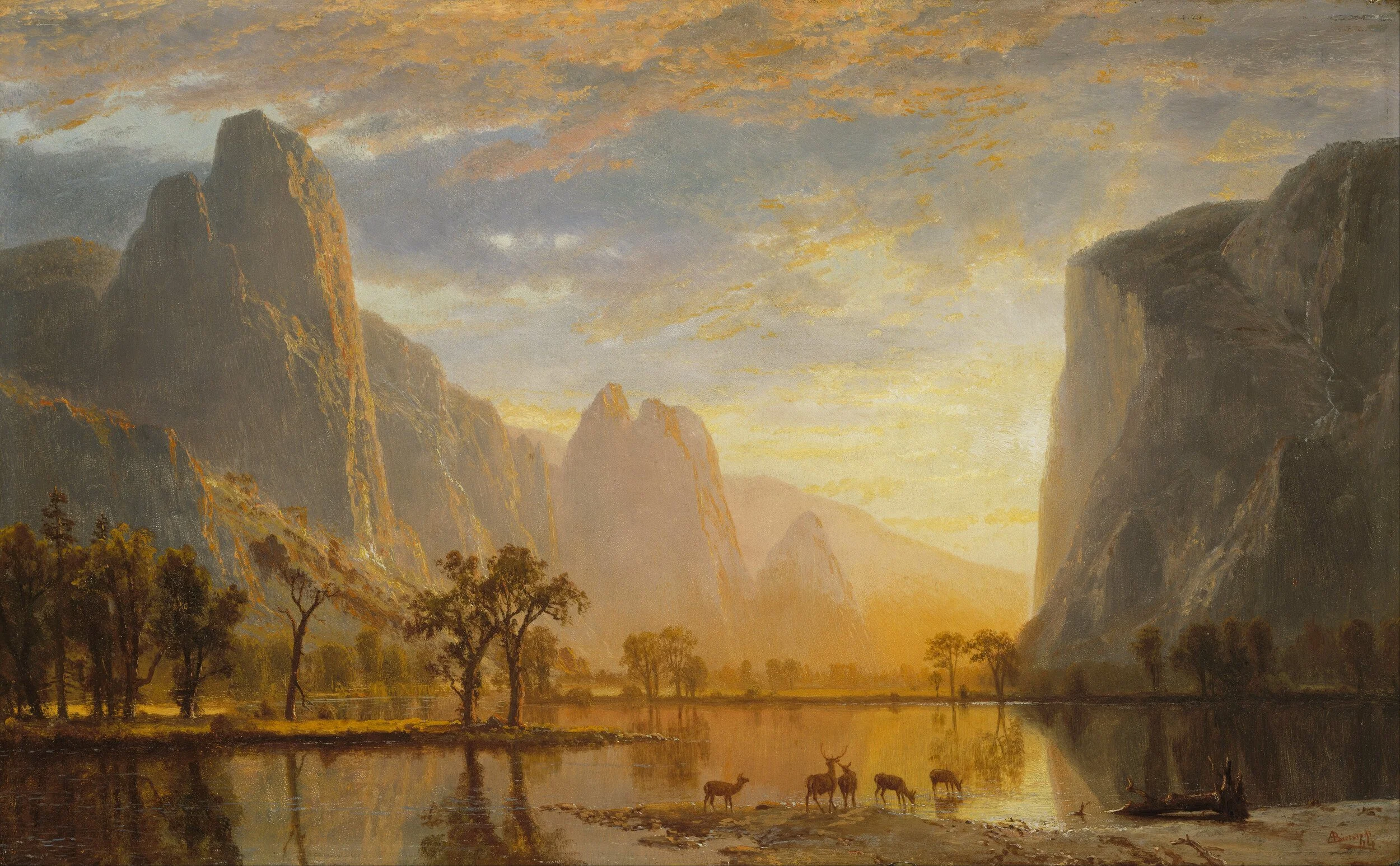
“Valley of Yosemite” — Albert Bierstadt
Painted after Bierstadt’s western travels, “Valley of Yosemite” turns the Yosemite landscape into a scene of stillness, scale, and light. Rather than emphasizing movement, the painting draws attention to the contrast between the quiet water below and the immense rock walls rising on either side, creating a view that feels both monumental and serene.
In the foreground, deer gather at the edge of reflective water while trees and low grasses soften the scene below the cliffs. Farther back, the valley opens toward glowing light and towering granite faces, with the atmosphere of sunrise or sunset spreading across the sky. The composition is grand, but it remains quiet, allowing space and light to carry the emotional force of the image.
Albert Bierstadt was one of the best-known painters of the American West and part of the second generation of the Hudson River School. He became famous for sweeping landscapes that combined detailed observation with dramatic scale, and his Yosemite paintings were especially praised in his own time.
Expressed on silk and paired with integrated illumination, the artwork takes on a different presence from traditional surfaces. The translucency of silk allows light to pass through the image, introducing a sense of depth and softness that changes with its surroundings. Rather than remaining a fixed image, the piece responds to light and its environment, shifting in presence throughout the day. Appearing quiet and refined in natural light, it becomes softly luminous as light grows more prominent.
“Valley of Yosemite” — Albert Bierstadt
Painted after Bierstadt’s western travels, “Valley of Yosemite” turns the Yosemite landscape into a scene of stillness, scale, and light. Rather than emphasizing movement, the painting draws attention to the contrast between the quiet water below and the immense rock walls rising on either side, creating a view that feels both monumental and serene.
In the foreground, deer gather at the edge of reflective water while trees and low grasses soften the scene below the cliffs. Farther back, the valley opens toward glowing light and towering granite faces, with the atmosphere of sunrise or sunset spreading across the sky. The composition is grand, but it remains quiet, allowing space and light to carry the emotional force of the image.
Albert Bierstadt was one of the best-known painters of the American West and part of the second generation of the Hudson River School. He became famous for sweeping landscapes that combined detailed observation with dramatic scale, and his Yosemite paintings were especially praised in his own time.
Expressed on silk and paired with integrated illumination, the artwork takes on a different presence from traditional surfaces. The translucency of silk allows light to pass through the image, introducing a sense of depth and softness that changes with its surroundings. Rather than remaining a fixed image, the piece responds to light and its environment, shifting in presence throughout the day. Appearing quiet and refined in natural light, it becomes softly luminous as light grows more prominent.