 Image 1 of 1
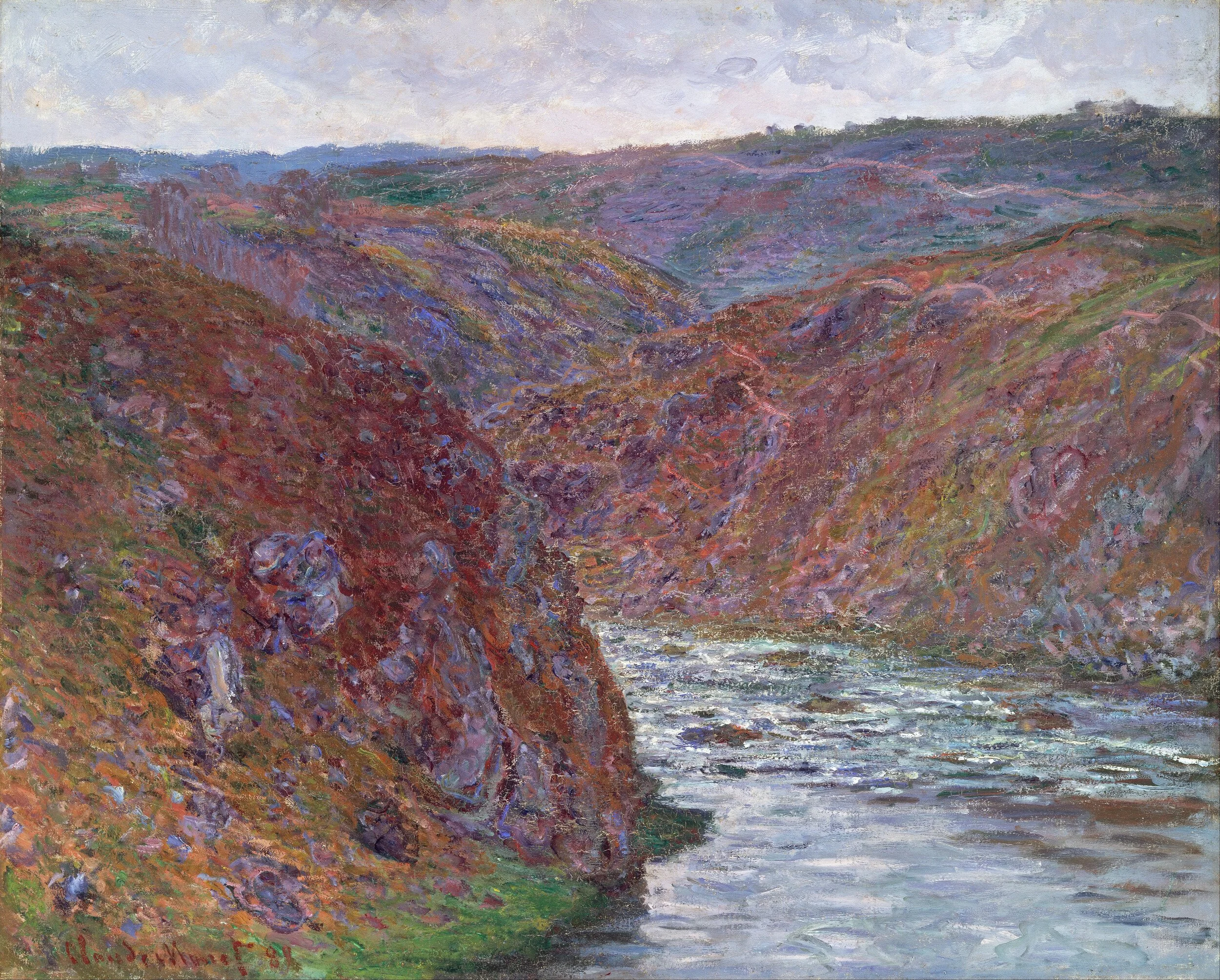
“Valley of the Creuse (Gray Day)” — Claude Monet
“Valley of the Creuse (Gray Day)” belongs to Monet’s remarkable series of paintings from the Creuse valley in 1889, where he explored the same landscape under changing light and weather. In this version, the emphasis falls not on brilliance or sunlit color, but on muted atmosphere and the slow movement of water through a rocky ravine.
The composition is built from slope, stone, and current. The river cuts through the center of the scene, while the surrounding banks rise in broken layers of violet, rust, and green. Unlike a broad panoramic view, this landscape feels compressed and immediate, with the terrain pressing close around the water. The gray day of the title is not dullness but restraint, allowing subtle tonal shifts to shape the mood.
Claude Monet is best known for turning light and atmosphere into the central subject of painting. Even in a rugged valley scene like this, he avoids rigid detail in favor of color relationships and shifting perception, allowing the landscape to feel observed in time rather than fixed in form.
Expressed on silk and paired with integrated illumination, the artwork takes on a different presence from traditional surfaces. The translucency of silk allows light to pass through the image, introducing a sense of depth and softness that changes with its surroundings. Rather than remaining a fixed image, the piece responds to light and its environment, shifting in presence throughout the day. Appearing quiet and refined in natural light, it becomes softly luminous as light grows more prominent.
“Valley of the Creuse (Gray Day)” — Claude Monet
“Valley of the Creuse (Gray Day)” belongs to Monet’s remarkable series of paintings from the Creuse valley in 1889, where he explored the same landscape under changing light and weather. In this version, the emphasis falls not on brilliance or sunlit color, but on muted atmosphere and the slow movement of water through a rocky ravine.
The composition is built from slope, stone, and current. The river cuts through the center of the scene, while the surrounding banks rise in broken layers of violet, rust, and green. Unlike a broad panoramic view, this landscape feels compressed and immediate, with the terrain pressing close around the water. The gray day of the title is not dullness but restraint, allowing subtle tonal shifts to shape the mood.
Claude Monet is best known for turning light and atmosphere into the central subject of painting. Even in a rugged valley scene like this, he avoids rigid detail in favor of color relationships and shifting perception, allowing the landscape to feel observed in time rather than fixed in form.
Expressed on silk and paired with integrated illumination, the artwork takes on a different presence from traditional surfaces. The translucency of silk allows light to pass through the image, introducing a sense of depth and softness that changes with its surroundings. Rather than remaining a fixed image, the piece responds to light and its environment, shifting in presence throughout the day. Appearing quiet and refined in natural light, it becomes softly luminous as light grows more prominent.