 Image 1 of 1
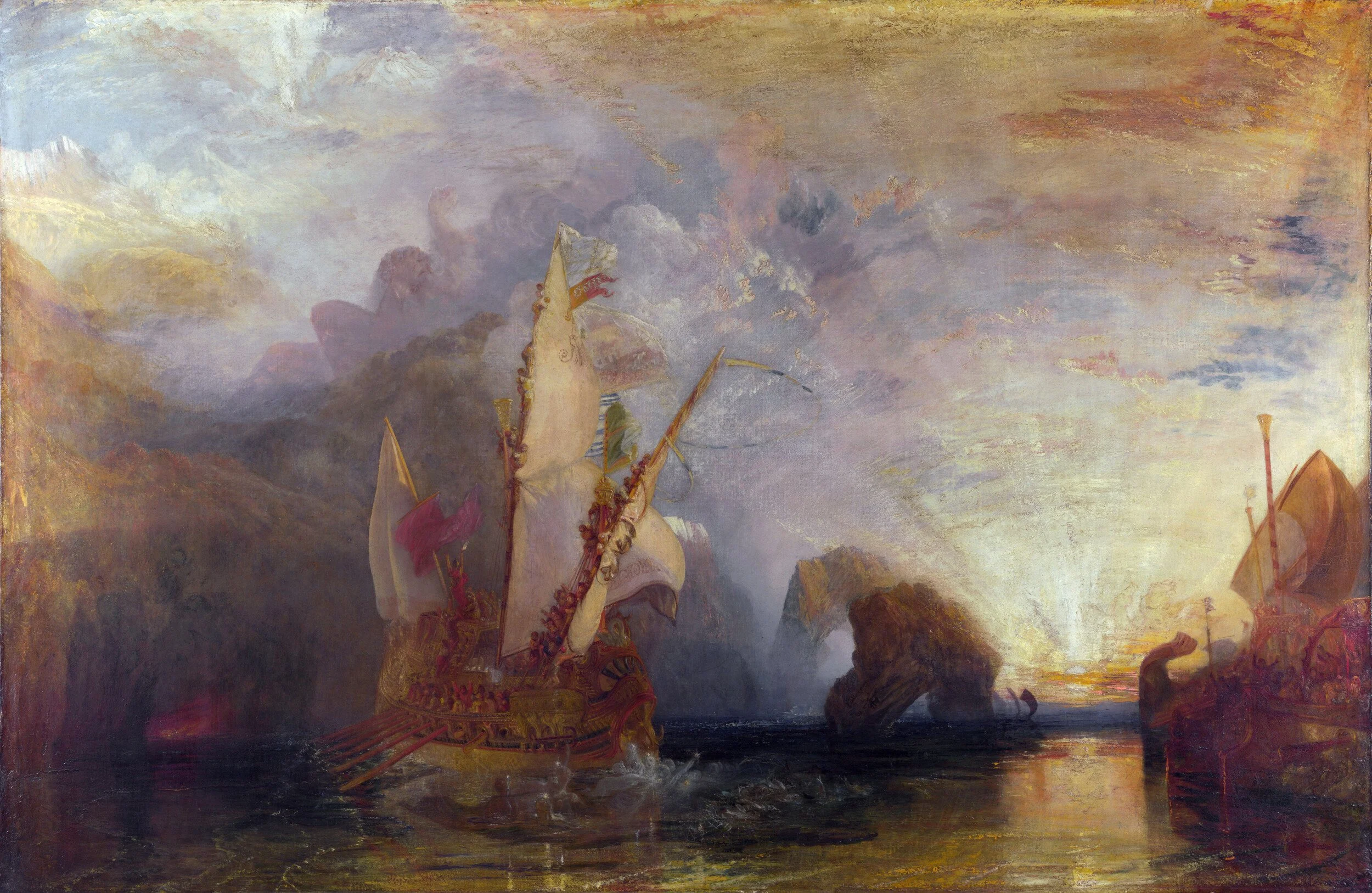
“Ulysses Deriding Polyphemus” — Joseph Mallord William Turner
“Ulysses Deriding Polyphemus” turns a scene from ancient myth into a dramatic vision of light, sea, and escape. Turner shows Ulysses sailing away after blinding the giant Polyphemus, with the story unfolding through glowing atmosphere rather than hard narrative detail. The painting feels theatrical and dreamlike, balancing triumph, danger, and the strange beauty of a world shaped by myth.
The composition is built around the contrast between dark water, radiant sky, and the ornate ships moving through the scene. Ulysses’s vessel rises near the center, its pale sail and decorated forms catching the light, while the vast body of Polyphemus is barely visible in the surrounding cliffs and clouds. On the right, another ship and the bright opening of the sky pull the eye outward, giving the scene a sense of motion and departure.
Turner was one of the great painters of light and atmosphere, often using historical, literary, and mythological subjects as vehicles for visual drama. Here, the episode from Homer’s “Odyssey” becomes less a straightforward illustration than an encounter with color, movement, and glowing air, showing Turner’s ability to make light itself feel like the force driving the scene.
Expressed on silk and paired with integrated illumination, the artwork takes on a different presence from traditional surfaces. The translucency of silk allows light to pass through the image, introducing a sense of depth and softness that changes with its surroundings. Rather than remaining a fixed image, the piece responds to light and its environment, shifting in presence throughout the day. Appearing quiet and refined in natural light, it becomes softly luminous as light grows more prominent.
“Ulysses Deriding Polyphemus” — Joseph Mallord William Turner
“Ulysses Deriding Polyphemus” turns a scene from ancient myth into a dramatic vision of light, sea, and escape. Turner shows Ulysses sailing away after blinding the giant Polyphemus, with the story unfolding through glowing atmosphere rather than hard narrative detail. The painting feels theatrical and dreamlike, balancing triumph, danger, and the strange beauty of a world shaped by myth.
The composition is built around the contrast between dark water, radiant sky, and the ornate ships moving through the scene. Ulysses’s vessel rises near the center, its pale sail and decorated forms catching the light, while the vast body of Polyphemus is barely visible in the surrounding cliffs and clouds. On the right, another ship and the bright opening of the sky pull the eye outward, giving the scene a sense of motion and departure.
Turner was one of the great painters of light and atmosphere, often using historical, literary, and mythological subjects as vehicles for visual drama. Here, the episode from Homer’s “Odyssey” becomes less a straightforward illustration than an encounter with color, movement, and glowing air, showing Turner’s ability to make light itself feel like the force driving the scene.
Expressed on silk and paired with integrated illumination, the artwork takes on a different presence from traditional surfaces. The translucency of silk allows light to pass through the image, introducing a sense of depth and softness that changes with its surroundings. Rather than remaining a fixed image, the piece responds to light and its environment, shifting in presence throughout the day. Appearing quiet and refined in natural light, it becomes softly luminous as light grows more prominent.