 Image 1 of 1
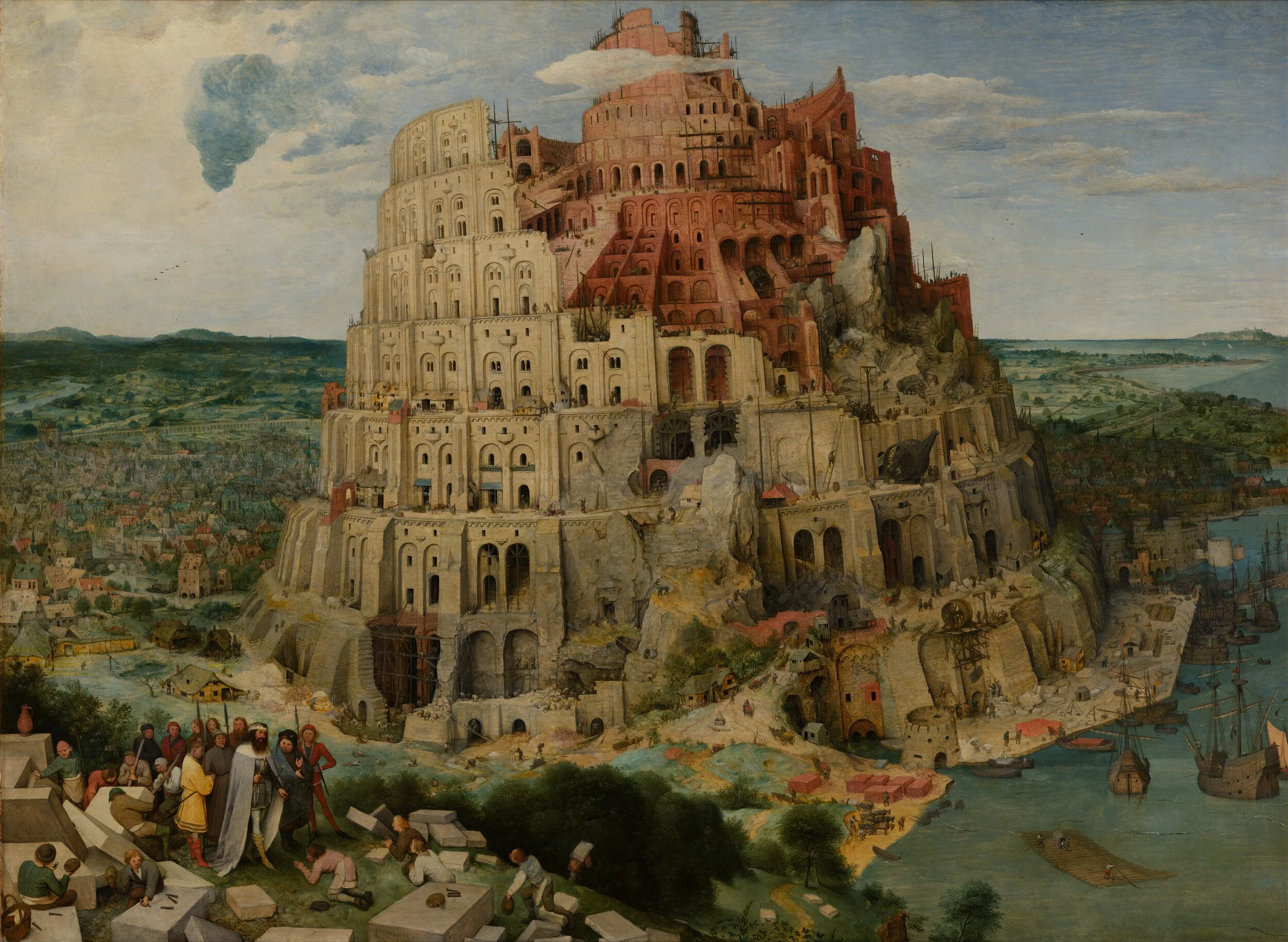
“The Tower of Babel” — Pieter Bruegel the Elder
“The Tower of Babel” presents the biblical monument as an immense construction rising above the surrounding city and harbor. Rather than treating the subject as a simple architectural fantasy, Bruegel turns it into a vast vision of ambition, labor, and instability, where grandeur and impending collapse seem to exist at the same time.
The composition is dominated by the spiraling mass of the tower, whose stacked arcades and construction platforms pull the eye upward while workers, scaffolds, ships, and roads animate the world around it. In the foreground, builders and stone cutters emphasize the human labor behind the structure, while the contrast between pale stone, reddish masonry, and open sky gives the tower unusual clarity despite its overwhelming scale.
Pieter Bruegel the Elder was one of the most inventive painters of the Northern Renaissance, known for combining biblical themes with close observation of everyday life. In “The Tower of Babel,” that ability allows him to unite monumental imagination with minute human activity, making the subject feel both universal and immediate.
Expressed on silk and paired with integrated illumination, the artwork takes on a different presence from traditional surfaces. The translucency of silk allows light to pass through the image, introducing a sense of depth and softness that changes with its surroundings. Rather than remaining a fixed image, the piece responds to light and its environment, shifting in presence throughout the day. Appearing quiet and refined in natural light, it becomes softly luminous as light grows more prominent.
“The Tower of Babel” — Pieter Bruegel the Elder
“The Tower of Babel” presents the biblical monument as an immense construction rising above the surrounding city and harbor. Rather than treating the subject as a simple architectural fantasy, Bruegel turns it into a vast vision of ambition, labor, and instability, where grandeur and impending collapse seem to exist at the same time.
The composition is dominated by the spiraling mass of the tower, whose stacked arcades and construction platforms pull the eye upward while workers, scaffolds, ships, and roads animate the world around it. In the foreground, builders and stone cutters emphasize the human labor behind the structure, while the contrast between pale stone, reddish masonry, and open sky gives the tower unusual clarity despite its overwhelming scale.
Pieter Bruegel the Elder was one of the most inventive painters of the Northern Renaissance, known for combining biblical themes with close observation of everyday life. In “The Tower of Babel,” that ability allows him to unite monumental imagination with minute human activity, making the subject feel both universal and immediate.
Expressed on silk and paired with integrated illumination, the artwork takes on a different presence from traditional surfaces. The translucency of silk allows light to pass through the image, introducing a sense of depth and softness that changes with its surroundings. Rather than remaining a fixed image, the piece responds to light and its environment, shifting in presence throughout the day. Appearing quiet and refined in natural light, it becomes softly luminous as light grows more prominent.