 Image 1 of 1
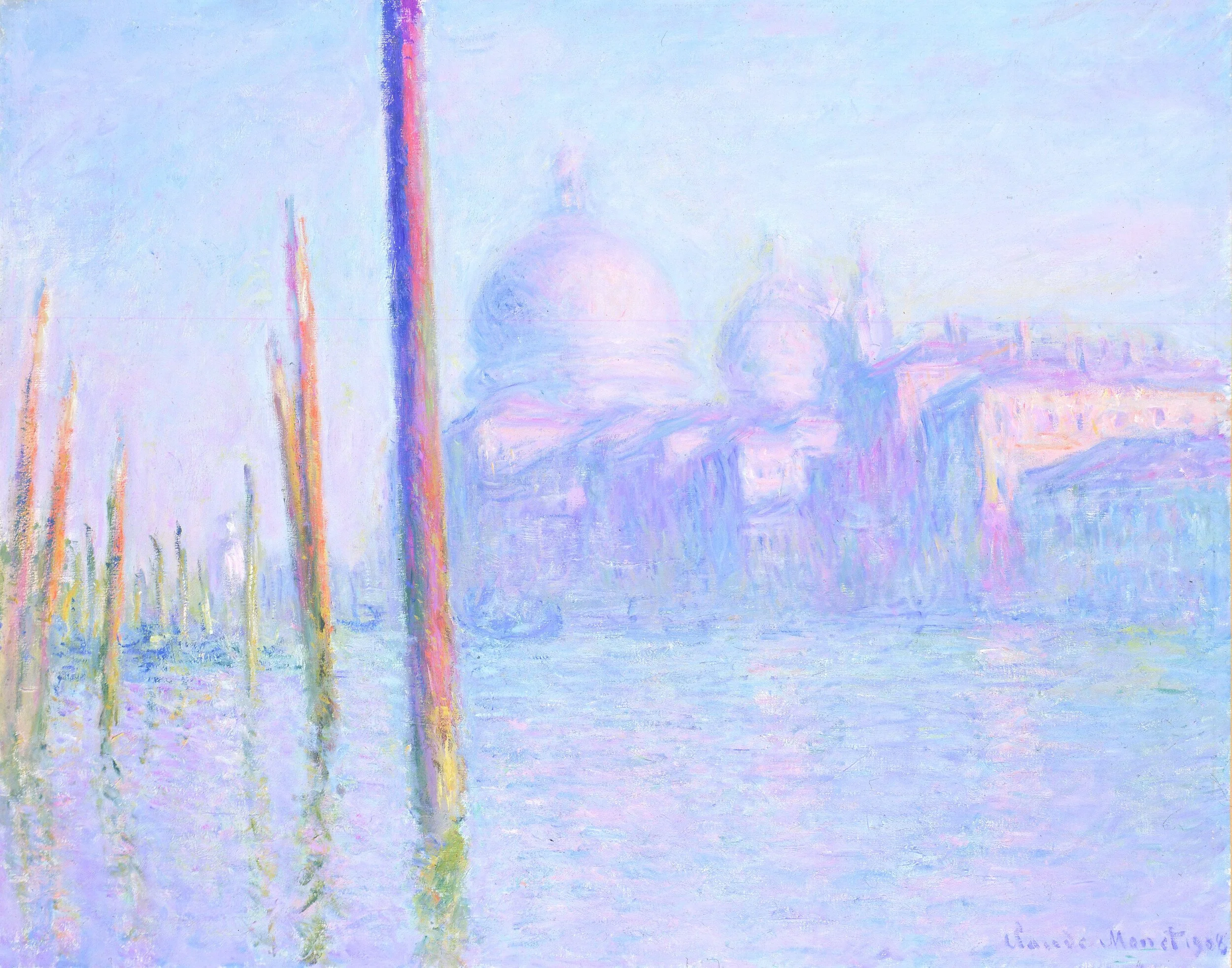
“The Grand Canal, Venice” — Claude Monet
Painted from the boat landing of the Palazzo Barbaro during his Venetian stay, Monet created “The Grand Canal, Venice” as part of the remarkable group of canvases he made in the city. The painting does not describe Venice through sharp architectural detail so much as through light, color, and reflection. Domes, facades, and poles seem to emerge through a veil of luminous atmosphere, giving the city a floating, almost immaterial presence.
The surface is built from delicate shifts of purple, blue, pink, and soft warm tones, so that water and architecture seem to dissolve into one another. Rather than separating forms clearly, Monet lets them shimmer at the edge of visibility, which gives the scene its distinctive softness. The canal becomes less a fixed setting than an experience of light suspended over water.
This treatment reflects Monet’s late interest in how changing conditions transform what is seen. In Venice, he found a city whose reflections, mist, and color harmonies suited that vision especially well. The result is a painting that feels both observational and dreamlike, rooted in a real place yet shaped by perception itself.
Expressed on silk and paired with integrated illumination, the artwork takes on a different presence from traditional surfaces. The translucency of silk allows light to pass through the image, introducing a sense of depth and softness that changes with its surroundings. Rather than remaining a fixed image, the piece responds to light and its environment, shifting in presence throughout the day. Appearing quiet and refined in natural light, it becomes softly luminous as light grows more prominent.
“The Grand Canal, Venice” — Claude Monet
Painted from the boat landing of the Palazzo Barbaro during his Venetian stay, Monet created “The Grand Canal, Venice” as part of the remarkable group of canvases he made in the city. The painting does not describe Venice through sharp architectural detail so much as through light, color, and reflection. Domes, facades, and poles seem to emerge through a veil of luminous atmosphere, giving the city a floating, almost immaterial presence.
The surface is built from delicate shifts of purple, blue, pink, and soft warm tones, so that water and architecture seem to dissolve into one another. Rather than separating forms clearly, Monet lets them shimmer at the edge of visibility, which gives the scene its distinctive softness. The canal becomes less a fixed setting than an experience of light suspended over water.
This treatment reflects Monet’s late interest in how changing conditions transform what is seen. In Venice, he found a city whose reflections, mist, and color harmonies suited that vision especially well. The result is a painting that feels both observational and dreamlike, rooted in a real place yet shaped by perception itself.
Expressed on silk and paired with integrated illumination, the artwork takes on a different presence from traditional surfaces. The translucency of silk allows light to pass through the image, introducing a sense of depth and softness that changes with its surroundings. Rather than remaining a fixed image, the piece responds to light and its environment, shifting in presence throughout the day. Appearing quiet and refined in natural light, it becomes softly luminous as light grows more prominent.