 Image 1 of 1
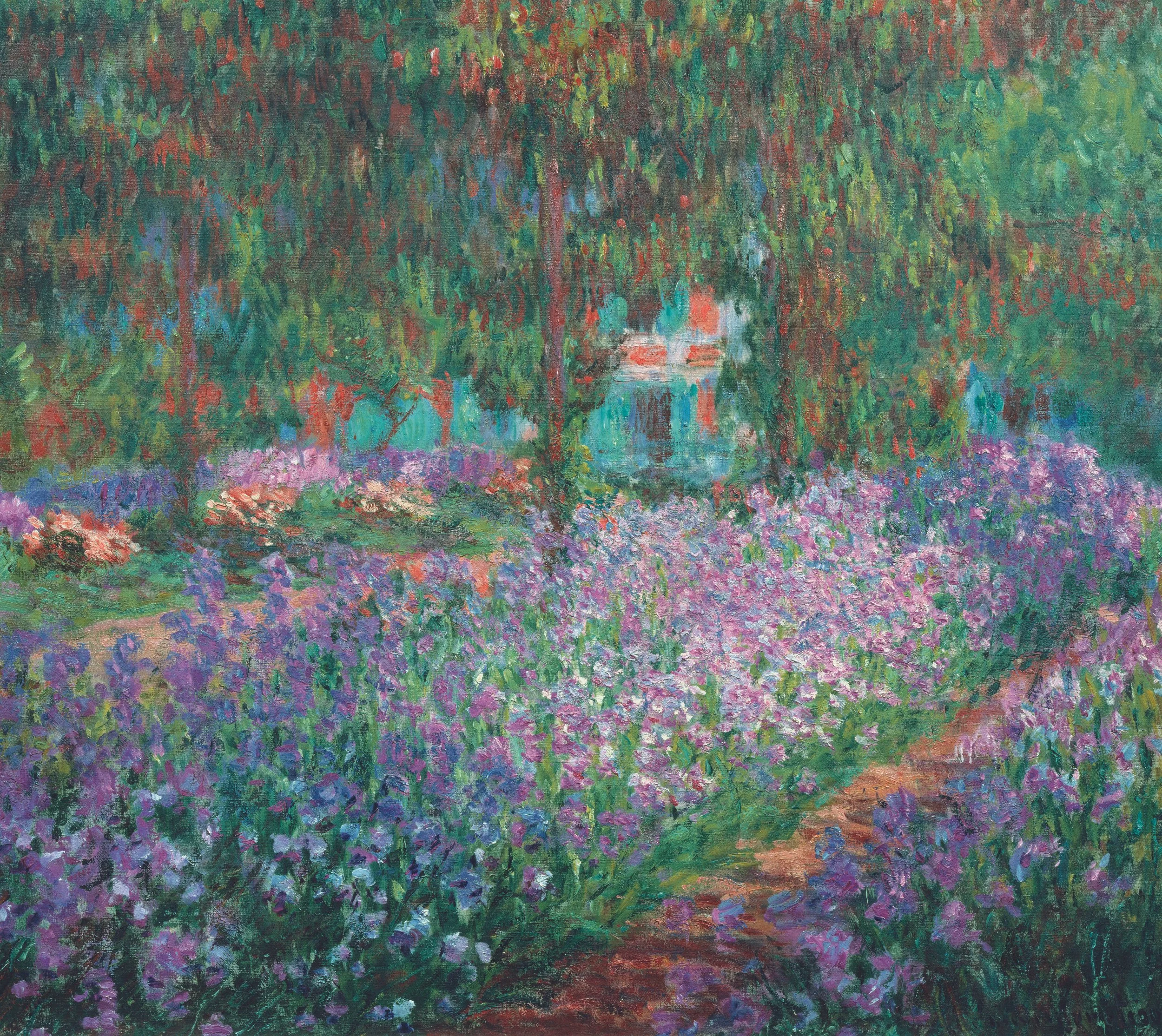
“The Artist’s Garden at Giverny” — Claude Monet
“The Artist’s Garden at Giverny” presents a dense flowering garden through color, repetition, and layered foliage. Rather than organizing the scene around a single focal point, Monet immerses the viewer in a living field of greens, purples, and scattered pinks, turning the garden into an experience of abundance and visual richness.
Diagonal beds of flowers spread across the foreground beneath hanging branches, while a small glimpse of the house appears beyond the flowers. The painting feels less like a botanical study than a close encounter with growth and color. Monet builds the image through repeated touches of paint, allowing leaves, petals, and light to shimmer together across the surface.
Late in his career, Monet increasingly turned to his garden at Giverny as a world of endless variation. Flowers, water, and foliage gave him a setting in which color and perception could take precedence over conventional structure, making the garden both a real place and a field of visual invention.
Expressed on silk and paired with integrated illumination, the artwork takes on a different presence from traditional surfaces. The translucency of silk allows light to pass through the image, introducing a sense of depth and softness that changes with its surroundings. Rather than remaining a fixed image, the piece responds to light and its environment, shifting in presence throughout the day. Appearing quiet and refined in natural light, it becomes softly luminous as light grows more prominent.
“The Artist’s Garden at Giverny” — Claude Monet
“The Artist’s Garden at Giverny” presents a dense flowering garden through color, repetition, and layered foliage. Rather than organizing the scene around a single focal point, Monet immerses the viewer in a living field of greens, purples, and scattered pinks, turning the garden into an experience of abundance and visual richness.
Diagonal beds of flowers spread across the foreground beneath hanging branches, while a small glimpse of the house appears beyond the flowers. The painting feels less like a botanical study than a close encounter with growth and color. Monet builds the image through repeated touches of paint, allowing leaves, petals, and light to shimmer together across the surface.
Late in his career, Monet increasingly turned to his garden at Giverny as a world of endless variation. Flowers, water, and foliage gave him a setting in which color and perception could take precedence over conventional structure, making the garden both a real place and a field of visual invention.
Expressed on silk and paired with integrated illumination, the artwork takes on a different presence from traditional surfaces. The translucency of silk allows light to pass through the image, introducing a sense of depth and softness that changes with its surroundings. Rather than remaining a fixed image, the piece responds to light and its environment, shifting in presence throughout the day. Appearing quiet and refined in natural light, it becomes softly luminous as light grows more prominent.