 Image 1 of 1
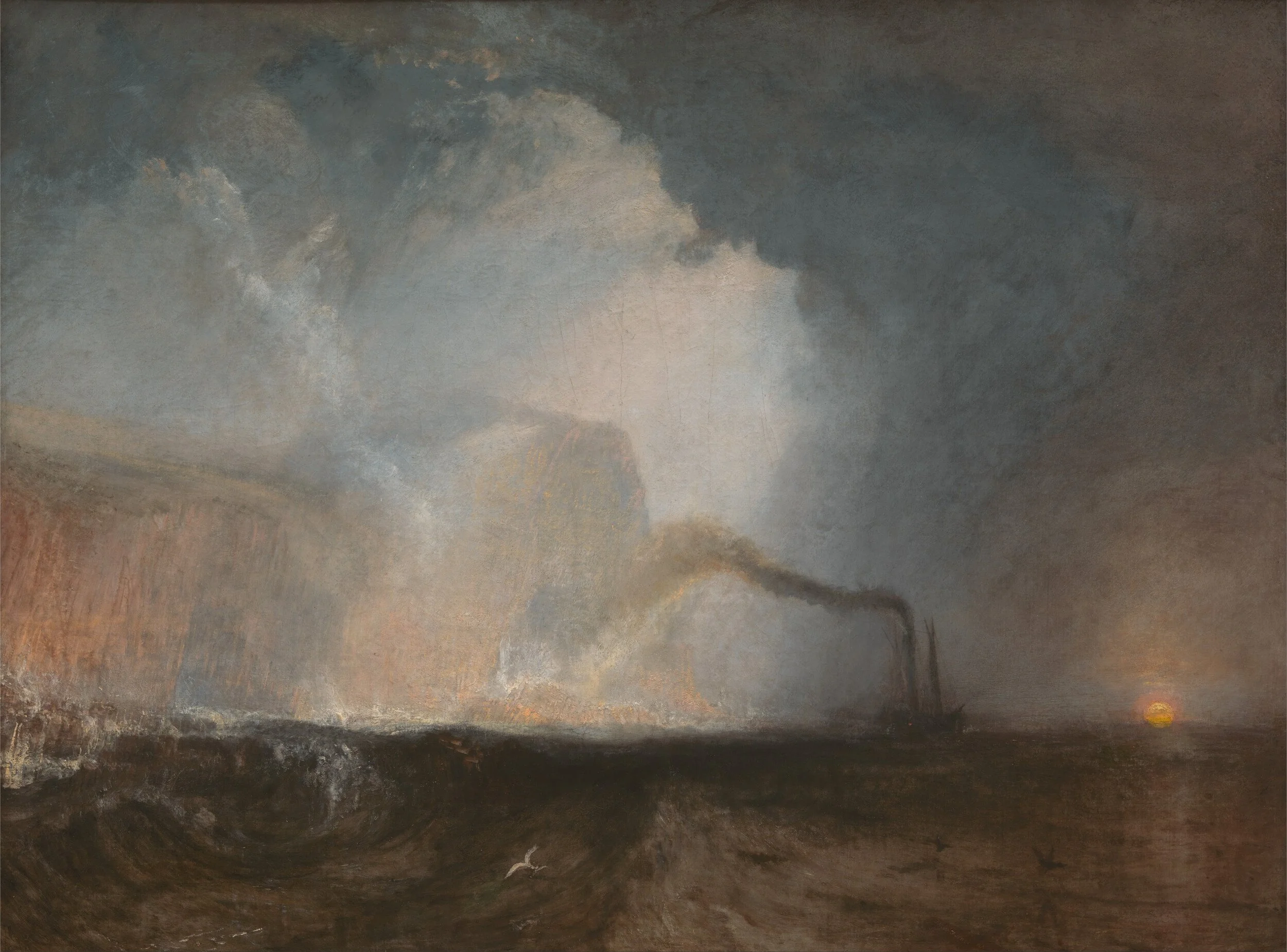
“Staffa, Fingal’s Cave” — Joseph Mallord William Turner
“Staffa, Fingal’s Cave” presents one of Turner’s most dramatic island and sea subjects, where weather, light, and geology combine into a scene of extraordinary scale. The painting is tied to Turner’s journey around Staffa in 1831 and to the island’s famous cave. Rather than presenting the site as a purely descriptive view, Turner turns it into a vision of dark rock, luminous water, and unstable atmosphere.
The composition is dominated by the massive curving darkness of the cave and sky, which frame a bright opening of sea and sunset near the horizon. A small steamboat moves near the cave, its smoke curling across the light, while waves roll beneath the entire scene in deep shadow. The painting feels both vast and compressed, with the viewer held inside the cave’s dark presence while looking outward into distance and light.
Turner repeatedly returned to sea, weather, and coastal geology as central subjects in his work. In paintings like this, he allows landscape and atmosphere to become inseparable, so that rock, sea, smoke, and light feel part of the same moving force.
Expressed on silk and paired with integrated illumination, the artwork takes on a different presence from traditional surfaces. The translucency of silk allows light to pass through the image, introducing a sense of depth and softness that changes with its surroundings. Rather than remaining a fixed image, the piece responds to light and its environment, shifting in presence throughout the day. Appearing quiet and refined in natural light, it becomes softly luminous as light grows more prominent.
“Staffa, Fingal’s Cave” — Joseph Mallord William Turner
“Staffa, Fingal’s Cave” presents one of Turner’s most dramatic island and sea subjects, where weather, light, and geology combine into a scene of extraordinary scale. The painting is tied to Turner’s journey around Staffa in 1831 and to the island’s famous cave. Rather than presenting the site as a purely descriptive view, Turner turns it into a vision of dark rock, luminous water, and unstable atmosphere.
The composition is dominated by the massive curving darkness of the cave and sky, which frame a bright opening of sea and sunset near the horizon. A small steamboat moves near the cave, its smoke curling across the light, while waves roll beneath the entire scene in deep shadow. The painting feels both vast and compressed, with the viewer held inside the cave’s dark presence while looking outward into distance and light.
Turner repeatedly returned to sea, weather, and coastal geology as central subjects in his work. In paintings like this, he allows landscape and atmosphere to become inseparable, so that rock, sea, smoke, and light feel part of the same moving force.
Expressed on silk and paired with integrated illumination, the artwork takes on a different presence from traditional surfaces. The translucency of silk allows light to pass through the image, introducing a sense of depth and softness that changes with its surroundings. Rather than remaining a fixed image, the piece responds to light and its environment, shifting in presence throughout the day. Appearing quiet and refined in natural light, it becomes softly luminous as light grows more prominent.