 Image 1 of 1
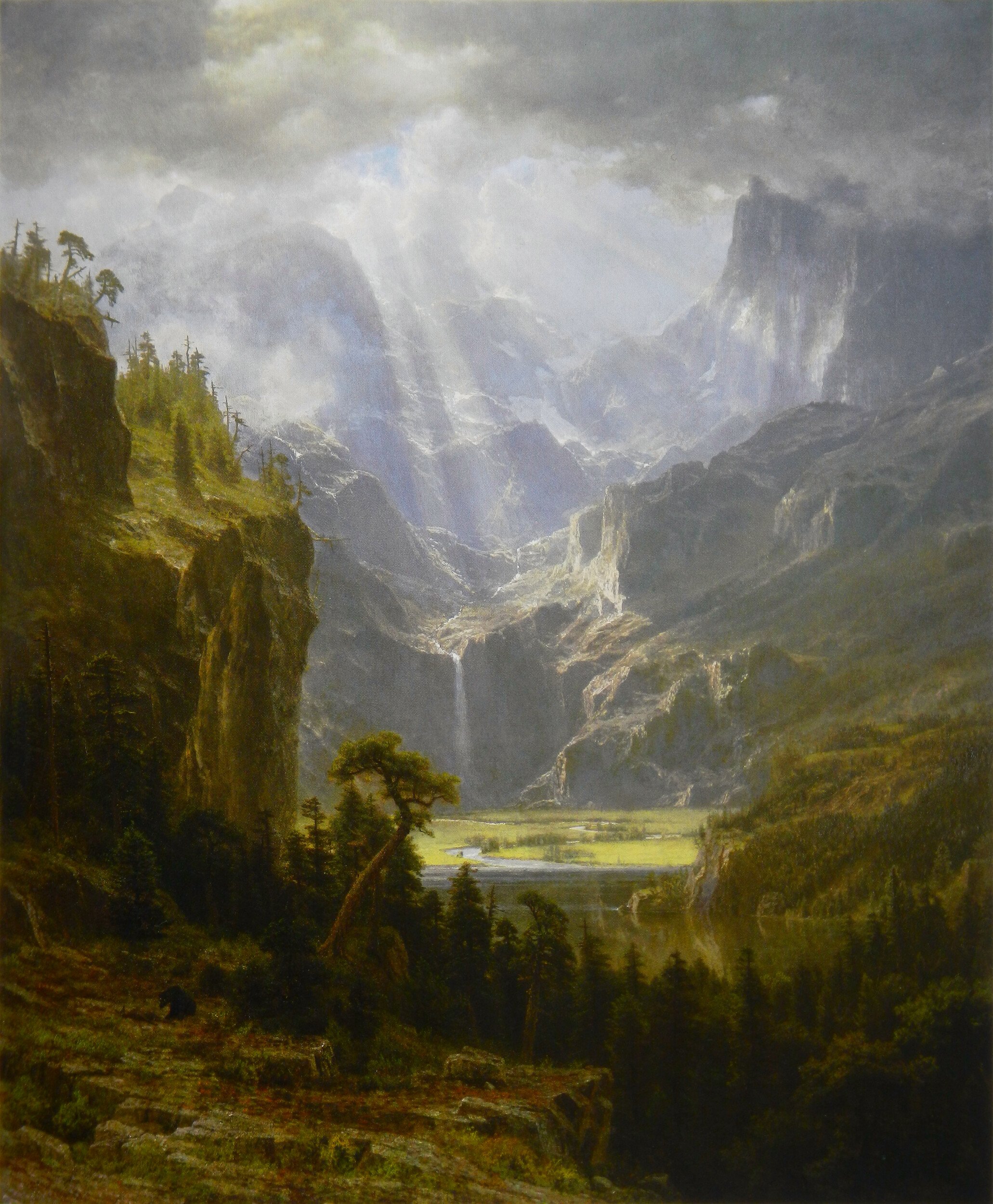
“The Rocky Mountains, Lander’s Peak” — Albert Bierstadt
“The Rocky Mountains, Lander’s Peak” transforms the American West into a monumental vision of wilderness, water, and light. The painting gathers cliffs, forest, lake, and distant peaks into a single panoramic design, creating a scene that feels both observed and deliberately heightened. Its effect depends not only on size, but on the way Bierstadt turns the land into an image of magnificence and radiance.
The composition opens from the wooded foreground toward the winding waterway and the vast mountain wall behind, with the central peak and glowing sky commanding the upper half of the painting. Cliff side, open space, and the careful spread of light through the clouds give the image a sense of calm and slow visual unfolding.
Albert Bierstadt made this painting after traveling west with Frederick W. Lander’s 1859 survey expedition, reaching the Wind River Range in present-day Wyoming. The work is a major result of that trip, where it participated in a broader nineteenth-century vision of the West.
Expressed on silk and paired with integrated illumination, the artwork takes on a different presence from traditional surfaces. The translucency of silk allows light to pass through the image, introducing a sense of depth and softness that changes with its surroundings. Rather than remaining a fixed image, the piece responds to light and its environment, shifting in presence throughout the day. Appearing quiet and refined in natural light, it becomes softly luminous as light grows more prominent.
“The Rocky Mountains, Lander’s Peak” — Albert Bierstadt
“The Rocky Mountains, Lander’s Peak” transforms the American West into a monumental vision of wilderness, water, and light. The painting gathers cliffs, forest, lake, and distant peaks into a single panoramic design, creating a scene that feels both observed and deliberately heightened. Its effect depends not only on size, but on the way Bierstadt turns the land into an image of magnificence and radiance.
The composition opens from the wooded foreground toward the winding waterway and the vast mountain wall behind, with the central peak and glowing sky commanding the upper half of the painting. Cliff side, open space, and the careful spread of light through the clouds give the image a sense of calm and slow visual unfolding.
Albert Bierstadt made this painting after traveling west with Frederick W. Lander’s 1859 survey expedition, reaching the Wind River Range in present-day Wyoming. The work is a major result of that trip, where it participated in a broader nineteenth-century vision of the West.
Expressed on silk and paired with integrated illumination, the artwork takes on a different presence from traditional surfaces. The translucency of silk allows light to pass through the image, introducing a sense of depth and softness that changes with its surroundings. Rather than remaining a fixed image, the piece responds to light and its environment, shifting in presence throughout the day. Appearing quiet and refined in natural light, it becomes softly luminous as light grows more prominent.