 Image 1 of 1
Rainy Season in the Tropics — Frederic Edwin Church
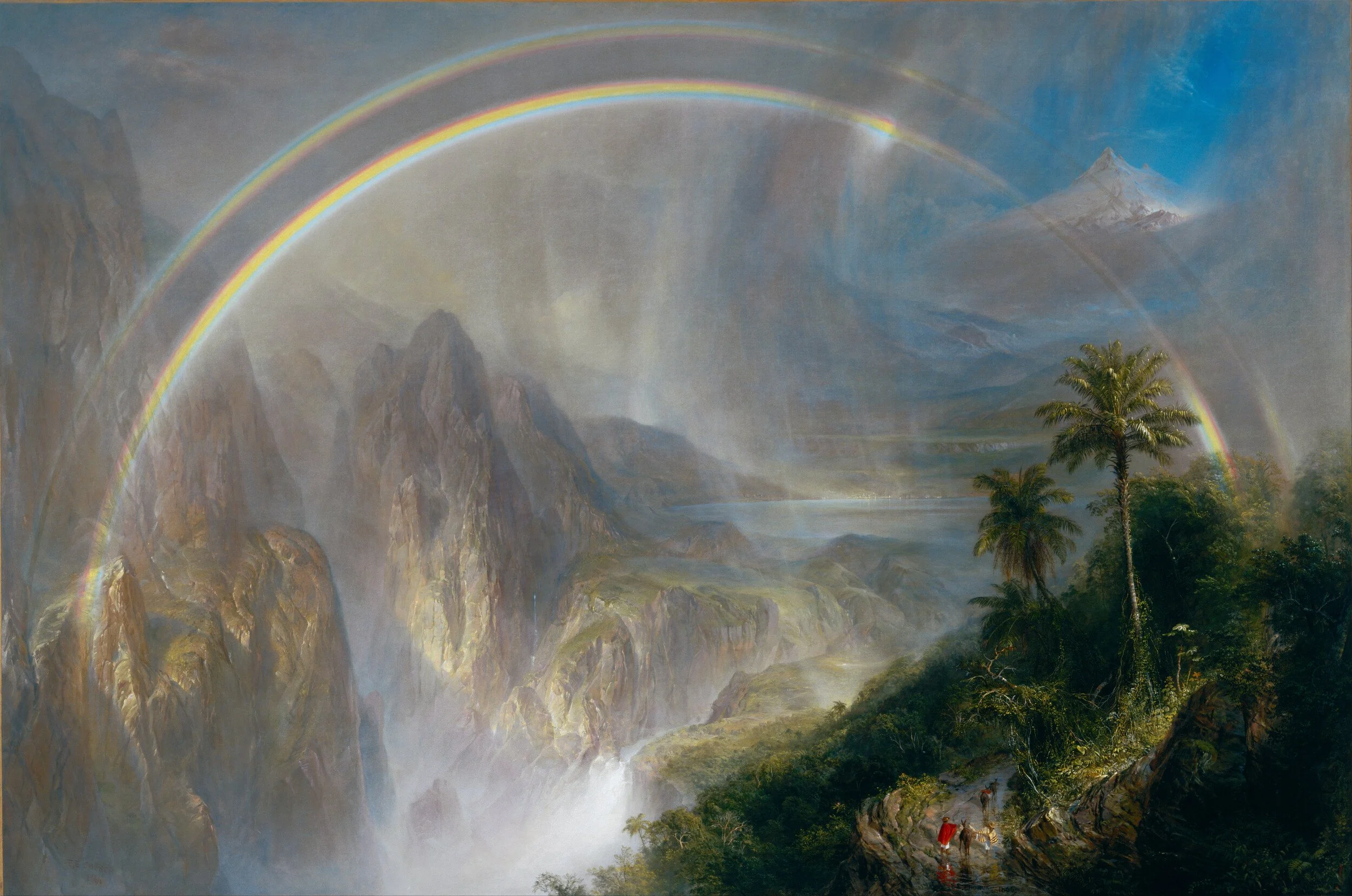
Painted after his tropical travels, Rainy Season in the Tropics brings together mist, mountains, dense vegetation, and a sweeping double rainbow in a landscape that feels both dramatic and serene. Though imagined in composition, the work draws on careful observation, combining atmospheric effects with the richness of the natural world.
Frederic Edwin Church was one of the most celebrated American landscape painters of the nineteenth century, known for his large-scale views, luminous light, and remarkable attention to natural detail. In this painting, those qualities come together in a scene often understood as one of renewal, where scientific precision and emotional symbolism coexist.
Expressed on silk and paired with integrated illumination, the artwork takes on a different presence from traditional surfaces. The translucency of silk allows light to pass through the image, introducing a sense of depth and softness that changes with its surroundings. Rather than remaining a fixed image, the piece responds to light and its environment, shifting in presence throughout the day. Appearing quiet and refined in natural light, it becomes softly luminous as light grows more prominent.
Rainy Season in the Tropics — Frederic Edwin Church
Painted after his tropical travels, Rainy Season in the Tropics brings together mist, mountains, dense vegetation, and a sweeping double rainbow in a landscape that feels both dramatic and serene. Though imagined in composition, the work draws on careful observation, combining atmospheric effects with the richness of the natural world.
Frederic Edwin Church was one of the most celebrated American landscape painters of the nineteenth century, known for his large-scale views, luminous light, and remarkable attention to natural detail. In this painting, those qualities come together in a scene often understood as one of renewal, where scientific precision and emotional symbolism coexist.
Expressed on silk and paired with integrated illumination, the artwork takes on a different presence from traditional surfaces. The translucency of silk allows light to pass through the image, introducing a sense of depth and softness that changes with its surroundings. Rather than remaining a fixed image, the piece responds to light and its environment, shifting in presence throughout the day. Appearing quiet and refined in natural light, it becomes softly luminous as light grows more prominent.