 Image 1 of 1
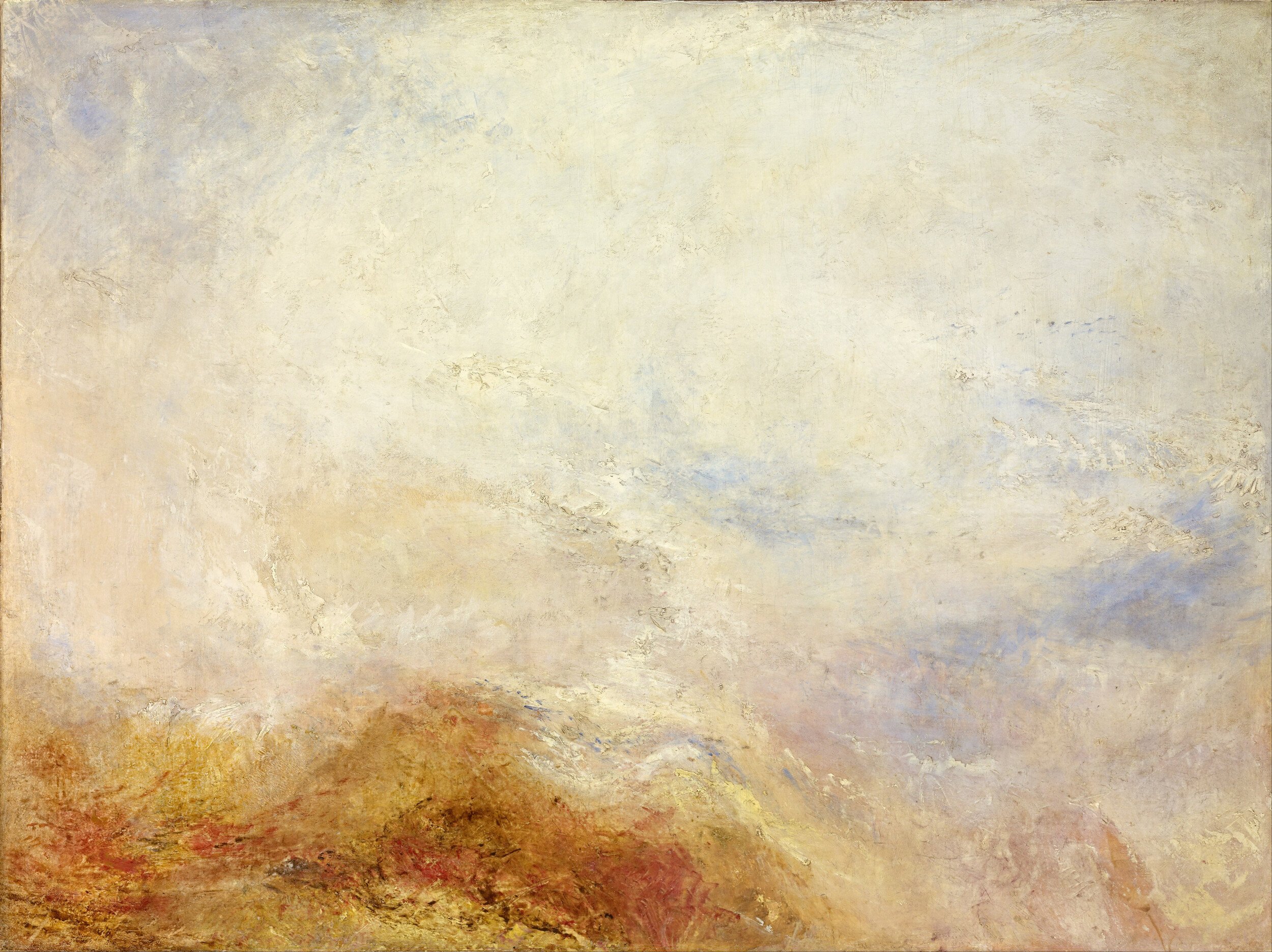
“Mountain Scene in the Aosta Valley” — Joseph Mallord William Turner
“Mountain Scene in the Aosta Valley” presents the Alps as a quiet field of light, cloud, and mountain form. Rather than relying on sharp detail, Turner allows the landscape to emerge through pale color and atmosphere. The result feels airy and dreamlike, with the mountains appearing gently through a broad expanse of light.
Soft whites, pale blues, and warm earth tones move across the painting, with more color and density near the lower edge and a wide field of light above. Mountain forms appear gradually through the haze, while cloud and sky remain closely bound to the landscape. The scene is spare and open, with the eye moving across shifting tones rather than fixed outlines.
Turner returned often to Alpine subjects, using them to explore light, weather, and distance in increasingly pared-down ways. In this painting, the Aosta Valley becomes less a detailed record of place than a quiet atmospheric view shaped by air, color, and changing light.
Expressed on silk and paired with integrated illumination, the artwork takes on a different presence from traditional surfaces. The translucency of silk allows light to pass through the image, introducing a sense of depth and softness that changes with its surroundings. Rather than remaining a fixed image, the piece responds to light and its environment, shifting in presence throughout the day. Appearing quiet and refined in natural light, it becomes softly luminous as light grows more prominent.
“Mountain Scene in the Aosta Valley” — Joseph Mallord William Turner
“Mountain Scene in the Aosta Valley” presents the Alps as a quiet field of light, cloud, and mountain form. Rather than relying on sharp detail, Turner allows the landscape to emerge through pale color and atmosphere. The result feels airy and dreamlike, with the mountains appearing gently through a broad expanse of light.
Soft whites, pale blues, and warm earth tones move across the painting, with more color and density near the lower edge and a wide field of light above. Mountain forms appear gradually through the haze, while cloud and sky remain closely bound to the landscape. The scene is spare and open, with the eye moving across shifting tones rather than fixed outlines.
Turner returned often to Alpine subjects, using them to explore light, weather, and distance in increasingly pared-down ways. In this painting, the Aosta Valley becomes less a detailed record of place than a quiet atmospheric view shaped by air, color, and changing light.
Expressed on silk and paired with integrated illumination, the artwork takes on a different presence from traditional surfaces. The translucency of silk allows light to pass through the image, introducing a sense of depth and softness that changes with its surroundings. Rather than remaining a fixed image, the piece responds to light and its environment, shifting in presence throughout the day. Appearing quiet and refined in natural light, it becomes softly luminous as light grows more prominent.