 Image 1 of 1
“Les Andelys” — Paul Signac
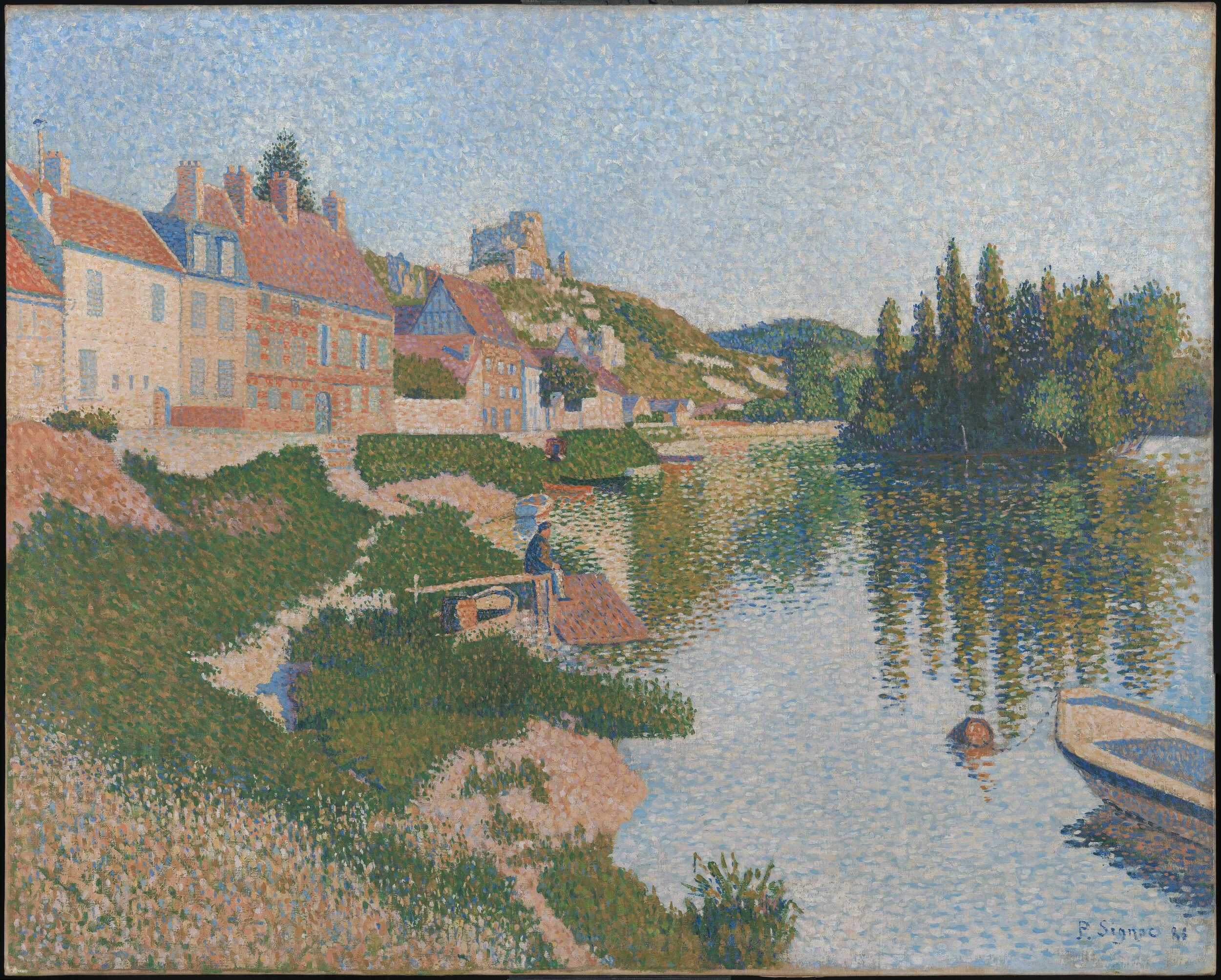
“Les Andelys” presents a riverside town through light, structure, and countless points of color. Painted during Signac’s early divisionist period, the work transforms houses, water, and trees into a shimmering surface built from small touches of blue, green, and white. It belongs to Signac’s first series of paintings executed in dots, which helps explain the painting’s calm yet vibrating surface.
The composition balances stillness with optical activity. Buildings rise along the left bank while the water opens quietly to the right, reflecting trees and sky in broken color. A seated figure near the shore gives the setting human scale, but the real subject is the transformation of ordinary riverside scenery into a luminous, vibrating field of paint. The scene feels calm from a distance, yet alive up close.
Paul Signac was a central figure in Neo-Impressionism and helped develop a method of painting in separate touches of color that depend on optical blending. In works like this, landscape is not simplified into flat pattern; it is rebuilt through color and light, creating both structure and shimmer.
Expressed on silk and paired with integrated illumination, the artwork takes on a different presence from traditional surfaces. The translucency of silk allows light to pass through the image, introducing a sense of depth and softness that changes with its surroundings. Rather than remaining a fixed image, the piece responds to light and its environment, shifting in presence throughout the day. Appearing quiet and refined in natural light, it becomes softly luminous as light grows more prominent.
“Les Andelys” — Paul Signac
“Les Andelys” presents a riverside town through light, structure, and countless points of color. Painted during Signac’s early divisionist period, the work transforms houses, water, and trees into a shimmering surface built from small touches of blue, green, and white. It belongs to Signac’s first series of paintings executed in dots, which helps explain the painting’s calm yet vibrating surface.
The composition balances stillness with optical activity. Buildings rise along the left bank while the water opens quietly to the right, reflecting trees and sky in broken color. A seated figure near the shore gives the setting human scale, but the real subject is the transformation of ordinary riverside scenery into a luminous, vibrating field of paint. The scene feels calm from a distance, yet alive up close.
Paul Signac was a central figure in Neo-Impressionism and helped develop a method of painting in separate touches of color that depend on optical blending. In works like this, landscape is not simplified into flat pattern; it is rebuilt through color and light, creating both structure and shimmer.
Expressed on silk and paired with integrated illumination, the artwork takes on a different presence from traditional surfaces. The translucency of silk allows light to pass through the image, introducing a sense of depth and softness that changes with its surroundings. Rather than remaining a fixed image, the piece responds to light and its environment, shifting in presence throughout the day. Appearing quiet and refined in natural light, it becomes softly luminous as light grows more prominent.