 Image 1 of 1
“Irises” — Vincent van Gogh
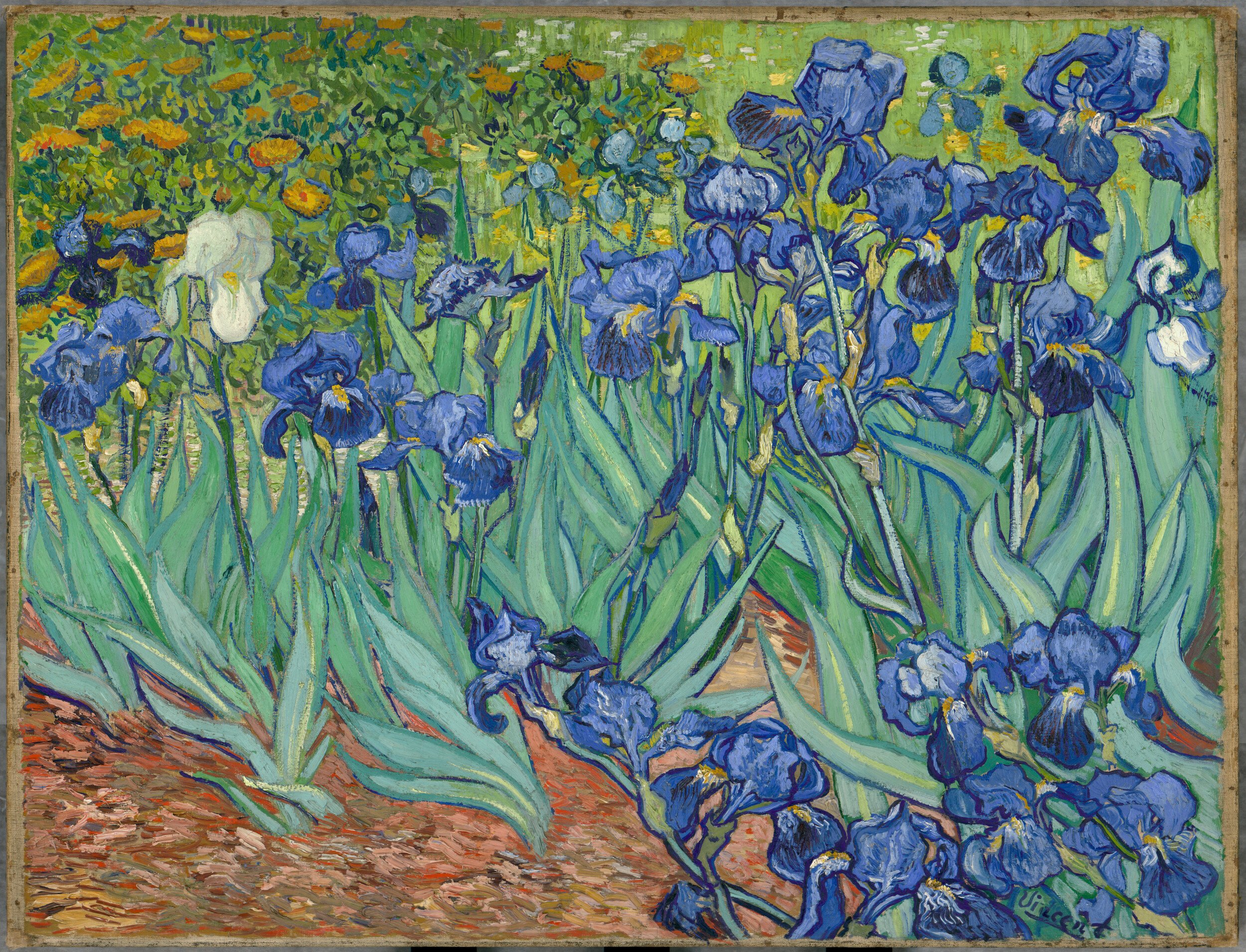
“Irises” presents a garden bed filled with blue irises and sweeping green leaves. The plants press close to the picture surface, creating an immediate and immersive view of the garden rather than a distant landscape. The painting feels vivid and alive, with each flower standing out through its own curve, tilt, and shape.
The irises rise from a warm earth-colored base into a field of green stems and leaves. Larger blue blossoms bloom at the ends of tall stems, while a single white iris appears among the sea of blue. Behind them, yellow flowers scatter across the green background, adding brightness and contrast without taking attention away from the irises.
Van Gogh painted “Irises” in 1889 during his stay at Saint-Rémy, where he studied the flowers so closely that each iris has its own distinct movement and shape. This attention gives the painting its unusual vitality: the flowers feel gathered together, but none of them feel exactly alike.
Expressed on silk and paired with integrated illumination, the artwork takes on a different presence from traditional surfaces. The translucency of silk allows light to pass through the image, introducing a sense of depth and softness that changes with its surroundings. Rather than remaining a fixed image, the piece responds to light and its environment, shifting in presence throughout the day. Appearing quiet and refined in natural light, it becomes softly luminous as light grows more prominent.
“Irises” — Vincent van Gogh
“Irises” presents a garden bed filled with blue irises and sweeping green leaves. The plants press close to the picture surface, creating an immediate and immersive view of the garden rather than a distant landscape. The painting feels vivid and alive, with each flower standing out through its own curve, tilt, and shape.
The irises rise from a warm earth-colored base into a field of green stems and leaves. Larger blue blossoms bloom at the ends of tall stems, while a single white iris appears among the sea of blue. Behind them, yellow flowers scatter across the green background, adding brightness and contrast without taking attention away from the irises.
Van Gogh painted “Irises” in 1889 during his stay at Saint-Rémy, where he studied the flowers so closely that each iris has its own distinct movement and shape. This attention gives the painting its unusual vitality: the flowers feel gathered together, but none of them feel exactly alike.
Expressed on silk and paired with integrated illumination, the artwork takes on a different presence from traditional surfaces. The translucency of silk allows light to pass through the image, introducing a sense of depth and softness that changes with its surroundings. Rather than remaining a fixed image, the piece responds to light and its environment, shifting in presence throughout the day. Appearing quiet and refined in natural light, it becomes softly luminous as light grows more prominent.