 Image 1 of 1
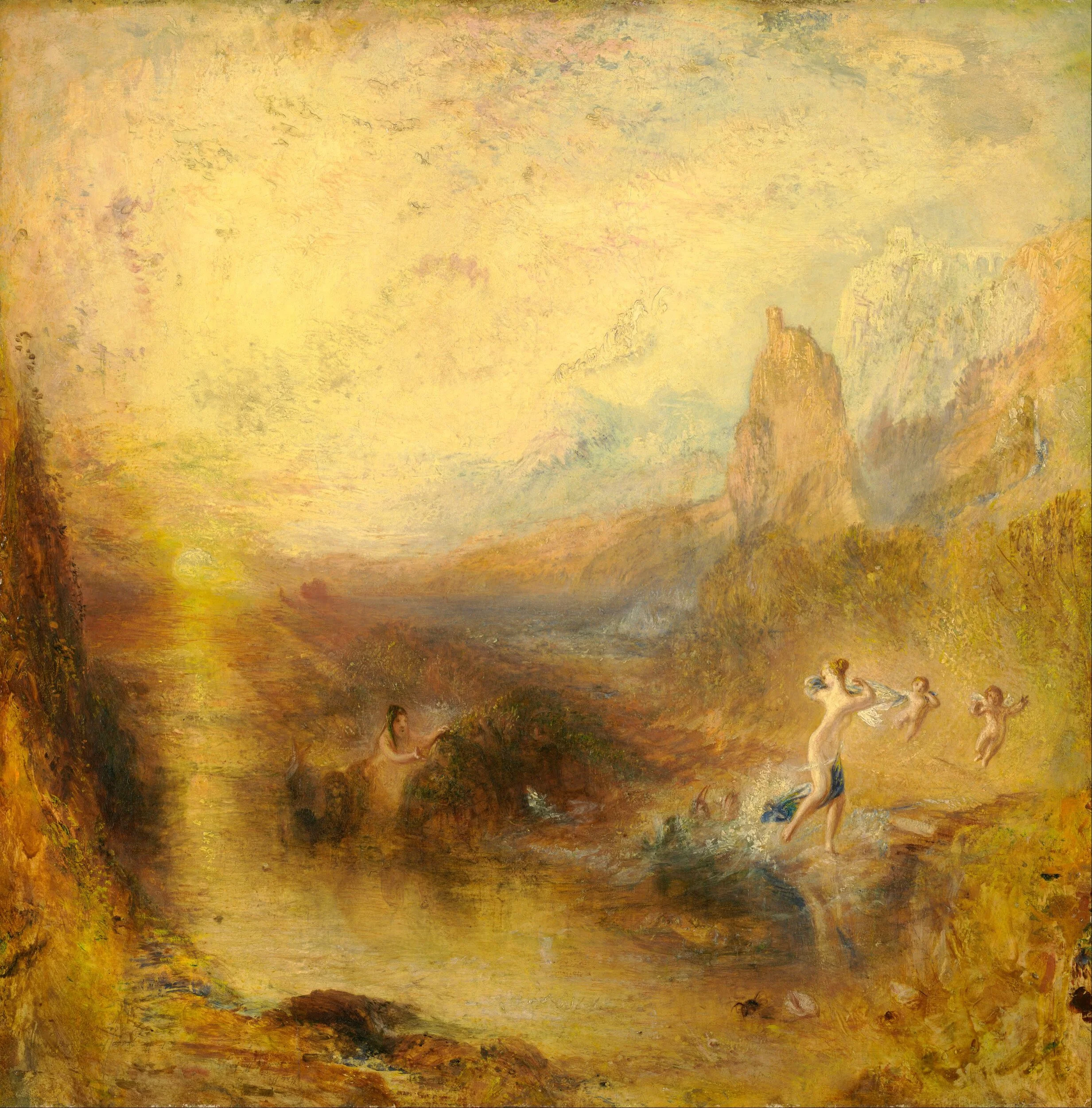
“Glaucus and Scylla” — Joseph Mallord William Turner
“Glaucus and Scylla” turns the classical myth of the sea god Glaucus and the nymph Scylla into a scene of blazing light, fluid movement, and unstable atmosphere. Turner presents it less as a fixed literary episode than as a vision of pursuit, water, and transformation. His handling of sunlight is especially striking here, flooding the scene with radiance and making light itself one of the painting’s defining forces.
The composition opens across a golden coastal space, where the low sun spreads across the water and the figures appear partly absorbed into the scene around them. Scylla and the surrounding forms are visible, but never sharply isolated. That softness gives the painting a dreamlike quality, allowing myth and landscape to merge into one another rather than remain separate.
J. M. W. Turner was celebrated for expressive color, imaginative landscapes, and his ability to make light itself the emotional center of a painting. In works like this, he transforms a literary subject into an atmosphere of vision, movement, and sensation.
Expressed on silk and paired with integrated illumination, the artwork takes on a different presence from traditional surfaces. The translucency of silk allows light to pass through the image, introducing a sense of depth and softness that changes with its surroundings. Rather than remaining a fixed image, the piece responds to light and its environment, shifting in presence throughout the day. Appearing quiet and refined in natural light, it becomes softly luminous as light grows more prominent.
“Glaucus and Scylla” — Joseph Mallord William Turner
“Glaucus and Scylla” turns the classical myth of the sea god Glaucus and the nymph Scylla into a scene of blazing light, fluid movement, and unstable atmosphere. Turner presents it less as a fixed literary episode than as a vision of pursuit, water, and transformation. His handling of sunlight is especially striking here, flooding the scene with radiance and making light itself one of the painting’s defining forces.
The composition opens across a golden coastal space, where the low sun spreads across the water and the figures appear partly absorbed into the scene around them. Scylla and the surrounding forms are visible, but never sharply isolated. That softness gives the painting a dreamlike quality, allowing myth and landscape to merge into one another rather than remain separate.
J. M. W. Turner was celebrated for expressive color, imaginative landscapes, and his ability to make light itself the emotional center of a painting. In works like this, he transforms a literary subject into an atmosphere of vision, movement, and sensation.
Expressed on silk and paired with integrated illumination, the artwork takes on a different presence from traditional surfaces. The translucency of silk allows light to pass through the image, introducing a sense of depth and softness that changes with its surroundings. Rather than remaining a fixed image, the piece responds to light and its environment, shifting in presence throughout the day. Appearing quiet and refined in natural light, it becomes softly luminous as light grows more prominent.