 Image 1 of 1
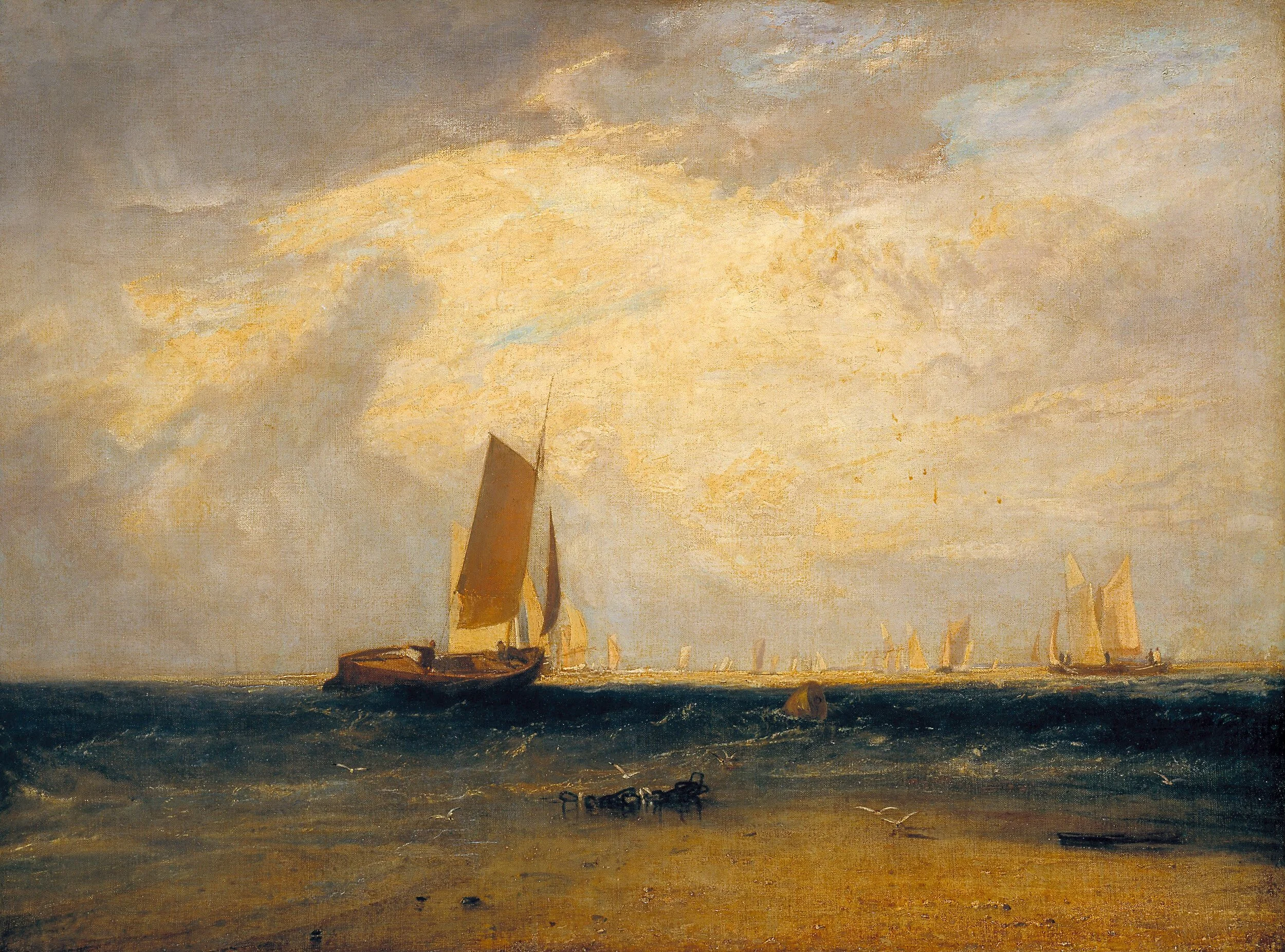
“Fishing at Blyth Sands as the Tide Rises” — Joseph Mallord William Turner
Exhibited in 1809, “Fishing at Blyth Sands as the Tide Rises” belongs to Turner’s early seascapes, where working boats, weather, and changing water conditions form the center of the scene. The painting focuses on dark sails set against a brighter distance, creating a strong contrast between the near craft and the receding line of smaller vessels beyond.
The foreground is low and immediate, with wet sand and shallow water catching the light while fishing boats move across the scene. The sky opens above them, and the rising tide itself becomes part of the subject, shaping both the composition and the atmosphere. The painting remains active and spacious at once, grounded in labor but lifted by light.
Turner’s marine paintings helped establish his reputation early in his career. Even in works like this, where the subject is practical and coastal, he gives sea and sky a larger emotional presence.
Expressed on silk and paired with integrated illumination, the artwork takes on a different presence from traditional surfaces. The translucency of silk allows light to pass through the image, introducing a sense of depth and softness that changes with its surroundings. Rather than remaining a fixed image, the piece responds to light and its environment, shifting in presence throughout the day. Appearing quiet and refined in natural light, it becomes softly luminous as light grows more prominent.
“Fishing at Blyth Sands as the Tide Rises” — Joseph Mallord William Turner
Exhibited in 1809, “Fishing at Blyth Sands as the Tide Rises” belongs to Turner’s early seascapes, where working boats, weather, and changing water conditions form the center of the scene. The painting focuses on dark sails set against a brighter distance, creating a strong contrast between the near craft and the receding line of smaller vessels beyond.
The foreground is low and immediate, with wet sand and shallow water catching the light while fishing boats move across the scene. The sky opens above them, and the rising tide itself becomes part of the subject, shaping both the composition and the atmosphere. The painting remains active and spacious at once, grounded in labor but lifted by light.
Turner’s marine paintings helped establish his reputation early in his career. Even in works like this, where the subject is practical and coastal, he gives sea and sky a larger emotional presence.
Expressed on silk and paired with integrated illumination, the artwork takes on a different presence from traditional surfaces. The translucency of silk allows light to pass through the image, introducing a sense of depth and softness that changes with its surroundings. Rather than remaining a fixed image, the piece responds to light and its environment, shifting in presence throughout the day. Appearing quiet and refined in natural light, it becomes softly luminous as light grows more prominent.