 Image 1 of 1
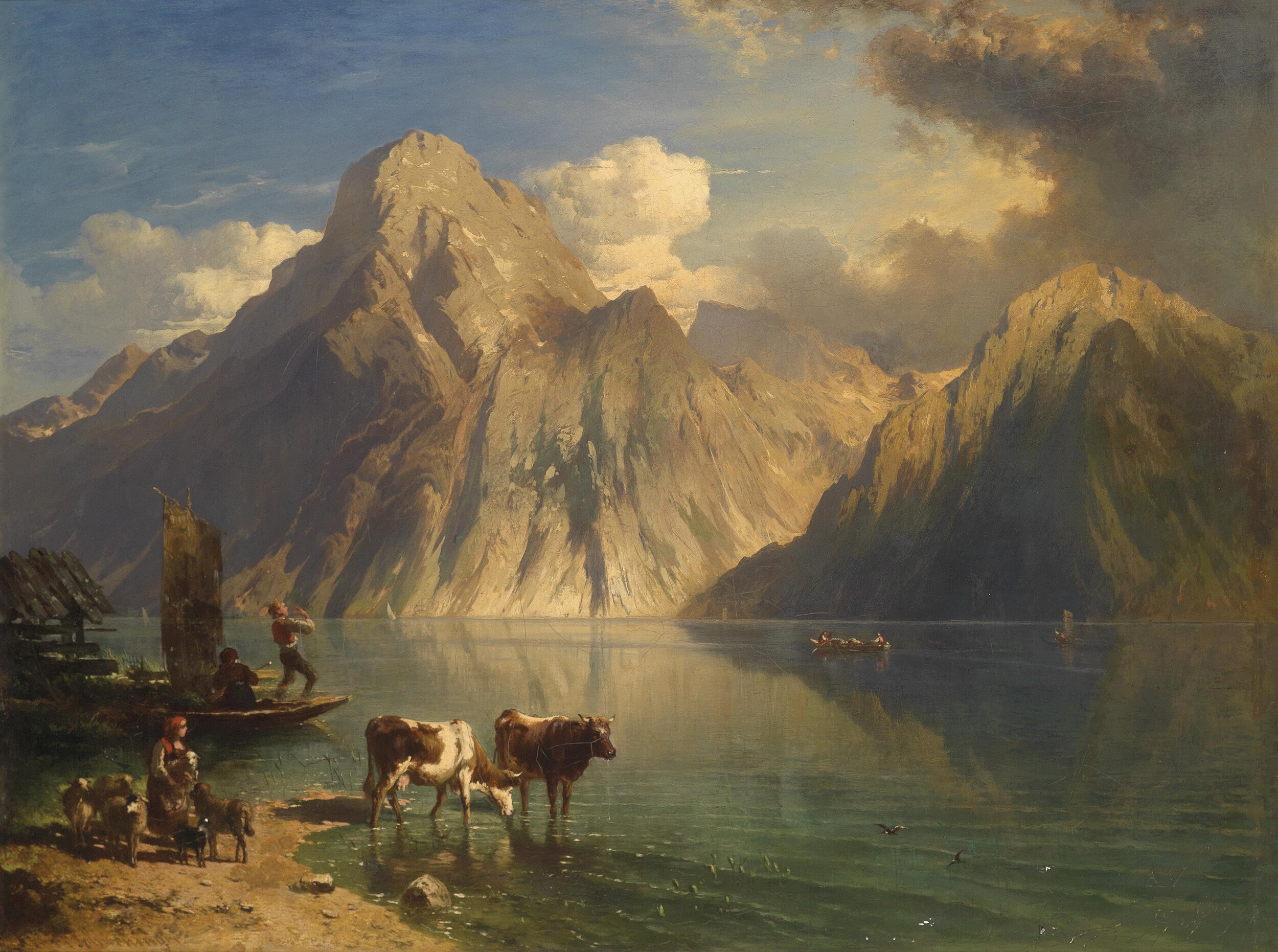
“Echo from Mount Traunstein” — Carl Schweninger
“Echo from Mount Traunstein” presents a dramatic lakeside mountain view shaped by height, still water, and the contrast between human life and overwhelming terrain. Rather than depending only on scale, the painting also depicts a young boy calling across the lake toward the mountain, giving the scene a more vivid relationship to its title.
The composition is anchored by the reflective lake and the towering mountain walls that rise almost vertically from the water. In the foreground, cattle, figures, and a small boat keep the scene connected to daily life, but the larger effect is one of grandeur and quiet awe. One figure near the shore appears to lean back and call outward across the lake, giving the title “Echo” a visual counterpart within the scene. Light falls across the rock faces in broad planes, while the stillness of the water holds the entire image together.
Carl Schweninger the Elder was an Austrian painter whose work included rural and landscape subjects. In a painting like this, the landscape is not merely descriptive; it becomes a stage for scale, reflection, and the meeting of ordinary life with the monumental character of the Alps.
Expressed on silk and paired with integrated illumination, the artwork takes on a different presence from traditional surfaces. The translucency of silk allows light to pass through the image, introducing a sense of depth and softness that changes with its surroundings. Rather than remaining a fixed image, the piece responds to light and its environment, shifting in presence throughout the day. Appearing quiet and refined in natural light, it becomes softly luminous as light grows more prominent.
“Echo from Mount Traunstein” — Carl Schweninger
“Echo from Mount Traunstein” presents a dramatic lakeside mountain view shaped by height, still water, and the contrast between human life and overwhelming terrain. Rather than depending only on scale, the painting also depicts a young boy calling across the lake toward the mountain, giving the scene a more vivid relationship to its title.
The composition is anchored by the reflective lake and the towering mountain walls that rise almost vertically from the water. In the foreground, cattle, figures, and a small boat keep the scene connected to daily life, but the larger effect is one of grandeur and quiet awe. One figure near the shore appears to lean back and call outward across the lake, giving the title “Echo” a visual counterpart within the scene. Light falls across the rock faces in broad planes, while the stillness of the water holds the entire image together.
Carl Schweninger the Elder was an Austrian painter whose work included rural and landscape subjects. In a painting like this, the landscape is not merely descriptive; it becomes a stage for scale, reflection, and the meeting of ordinary life with the monumental character of the Alps.
Expressed on silk and paired with integrated illumination, the artwork takes on a different presence from traditional surfaces. The translucency of silk allows light to pass through the image, introducing a sense of depth and softness that changes with its surroundings. Rather than remaining a fixed image, the piece responds to light and its environment, shifting in presence throughout the day. Appearing quiet and refined in natural light, it becomes softly luminous as light grows more prominent.