 Image 1 of 1
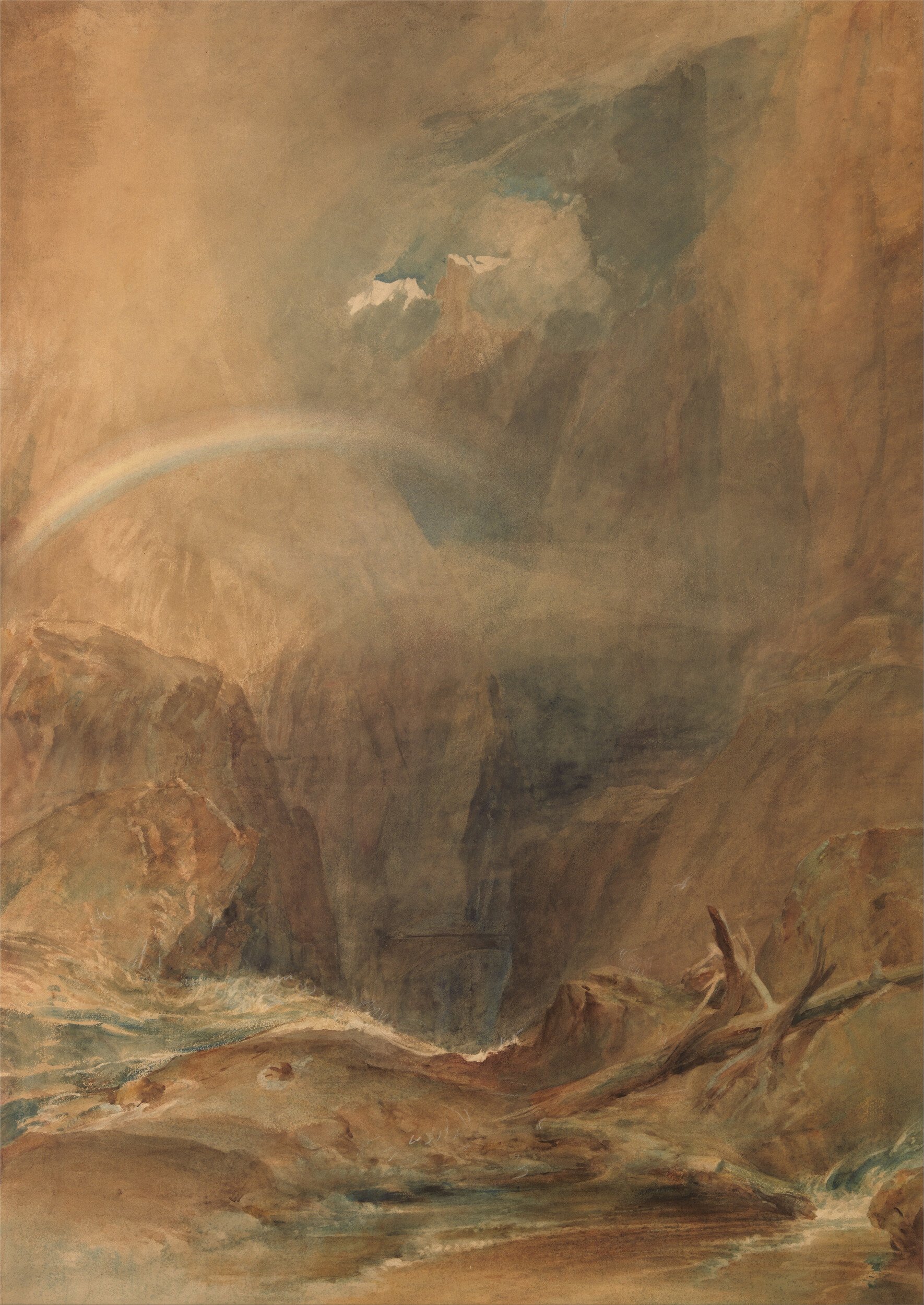
“Devil’s Bridge, Saint Gotthard Pass” — Joseph Mallord William Turner
“Devil’s Bridge, Saint Gotthard Pass” presents a steep mountain passage shaped by rushing water, towering rock, and a pale rainbow stretching across the scene. Rather than offering a broad panoramic view, the painting draws the eye into a confined and dramatic setting, where nature feels powerful, unstable, and alive.
The composition is built from vertical rock faces, broken ledges, and water moving through the foreground. Near the center, the dark opening of the pass pulls the eye inward, while the rainbow introduces a brief note of light and calm against the surrounding force of stone and water. Browns, golds, and muted blue-gray tones keep the image earthy and atmospheric, giving the scene a sense of rough grandeur.
Turner often treated mountain scenery not simply as a record of place, but as an opportunity to explore motion, atmosphere, and emotional intensity. In works connected to his Swiss subjects, landscape becomes less a static setting than an active encounter with light, weather, and terrain.
Expressed on silk and paired with integrated illumination, the artwork takes on a different presence from traditional surfaces. The translucency of silk allows light to pass through the image, introducing a sense of depth and softness that changes with its surroundings. Rather than remaining a fixed image, the piece responds to light and its environment, shifting in presence throughout the day. Appearing quiet and refined in natural light, it becomes softly luminous as light grows more prominent.
“Devil’s Bridge, Saint Gotthard Pass” — Joseph Mallord William Turner
“Devil’s Bridge, Saint Gotthard Pass” presents a steep mountain passage shaped by rushing water, towering rock, and a pale rainbow stretching across the scene. Rather than offering a broad panoramic view, the painting draws the eye into a confined and dramatic setting, where nature feels powerful, unstable, and alive.
The composition is built from vertical rock faces, broken ledges, and water moving through the foreground. Near the center, the dark opening of the pass pulls the eye inward, while the rainbow introduces a brief note of light and calm against the surrounding force of stone and water. Browns, golds, and muted blue-gray tones keep the image earthy and atmospheric, giving the scene a sense of rough grandeur.
Turner often treated mountain scenery not simply as a record of place, but as an opportunity to explore motion, atmosphere, and emotional intensity. In works connected to his Swiss subjects, landscape becomes less a static setting than an active encounter with light, weather, and terrain.
Expressed on silk and paired with integrated illumination, the artwork takes on a different presence from traditional surfaces. The translucency of silk allows light to pass through the image, introducing a sense of depth and softness that changes with its surroundings. Rather than remaining a fixed image, the piece responds to light and its environment, shifting in presence throughout the day. Appearing quiet and refined in natural light, it becomes softly luminous as light grows more prominent.