 Image 1 of 1
“Danish Harvest Landscape” — Anders Christian Lude
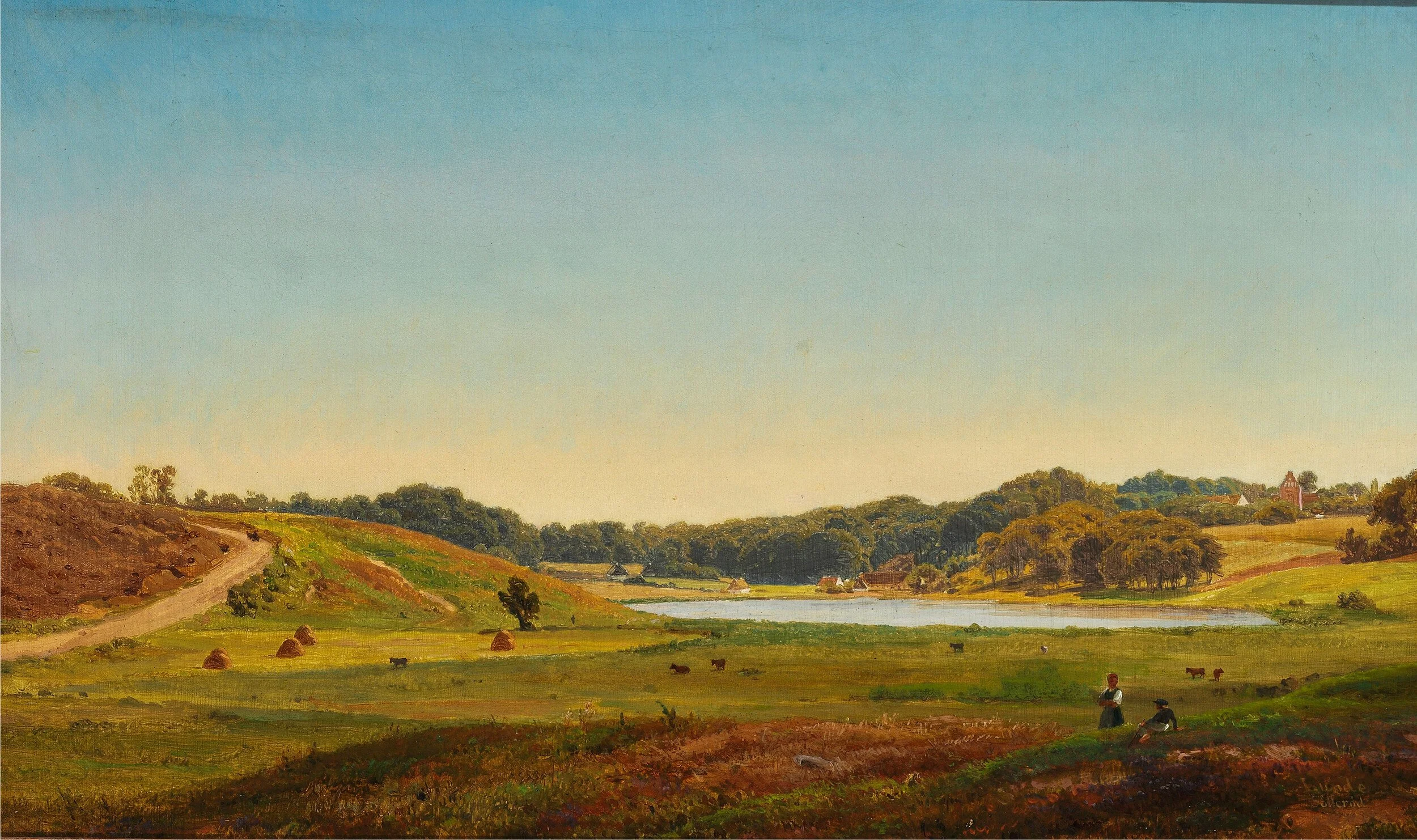
“Danish Harvest Landscape” presents an open rural scene shaped by low hills, a curving road, scattered haystacks, and a still lake beyond. Rather than depending on dramatic contrast or incident, the painting draws its effect from breadth, sunlight, and the quiet order of cultivated land. Small figures at the edge of the foreground help keep the view grounded in daily life without interrupting its calm.
The composition opens widely beneath a large clear sky, allowing the eye to travel across fields, water, and tree lines with very little obstruction. The road at the left gives the scene direction, while the haystacks, cattle, and distant farm buildings create a steady rhythm across the land. The result is spacious and restrained, with light doing more of the work than narrative.
Anders Christian Lude belonged to the tradition of nineteenth-century Danish landscape painting, which often found its strength in cultivated fields, open skies, and the quiet structure of rural life. In works like this, the land is not treated as dramatic wilderness, but as a lived and carefully observed environment shaped by light, labor, and seasonal order.
Expressed on silk and paired with integrated illumination, the artwork takes on a different presence from traditional surfaces. The translucency of silk allows light to pass through the image, introducing a sense of depth and softness that changes with its surroundings. Rather than remaining a fixed image, the piece responds to light and its environment, shifting in presence throughout the day. Appearing quiet and refined in natural light, it becomes softly luminous as light grows more prominent.
“Danish Harvest Landscape” — Anders Christian Lude
“Danish Harvest Landscape” presents an open rural scene shaped by low hills, a curving road, scattered haystacks, and a still lake beyond. Rather than depending on dramatic contrast or incident, the painting draws its effect from breadth, sunlight, and the quiet order of cultivated land. Small figures at the edge of the foreground help keep the view grounded in daily life without interrupting its calm.
The composition opens widely beneath a large clear sky, allowing the eye to travel across fields, water, and tree lines with very little obstruction. The road at the left gives the scene direction, while the haystacks, cattle, and distant farm buildings create a steady rhythm across the land. The result is spacious and restrained, with light doing more of the work than narrative.
Anders Christian Lude belonged to the tradition of nineteenth-century Danish landscape painting, which often found its strength in cultivated fields, open skies, and the quiet structure of rural life. In works like this, the land is not treated as dramatic wilderness, but as a lived and carefully observed environment shaped by light, labor, and seasonal order.
Expressed on silk and paired with integrated illumination, the artwork takes on a different presence from traditional surfaces. The translucency of silk allows light to pass through the image, introducing a sense of depth and softness that changes with its surroundings. Rather than remaining a fixed image, the piece responds to light and its environment, shifting in presence throughout the day. Appearing quiet and refined in natural light, it becomes softly luminous as light grows more prominent.