 Image 1 of 1
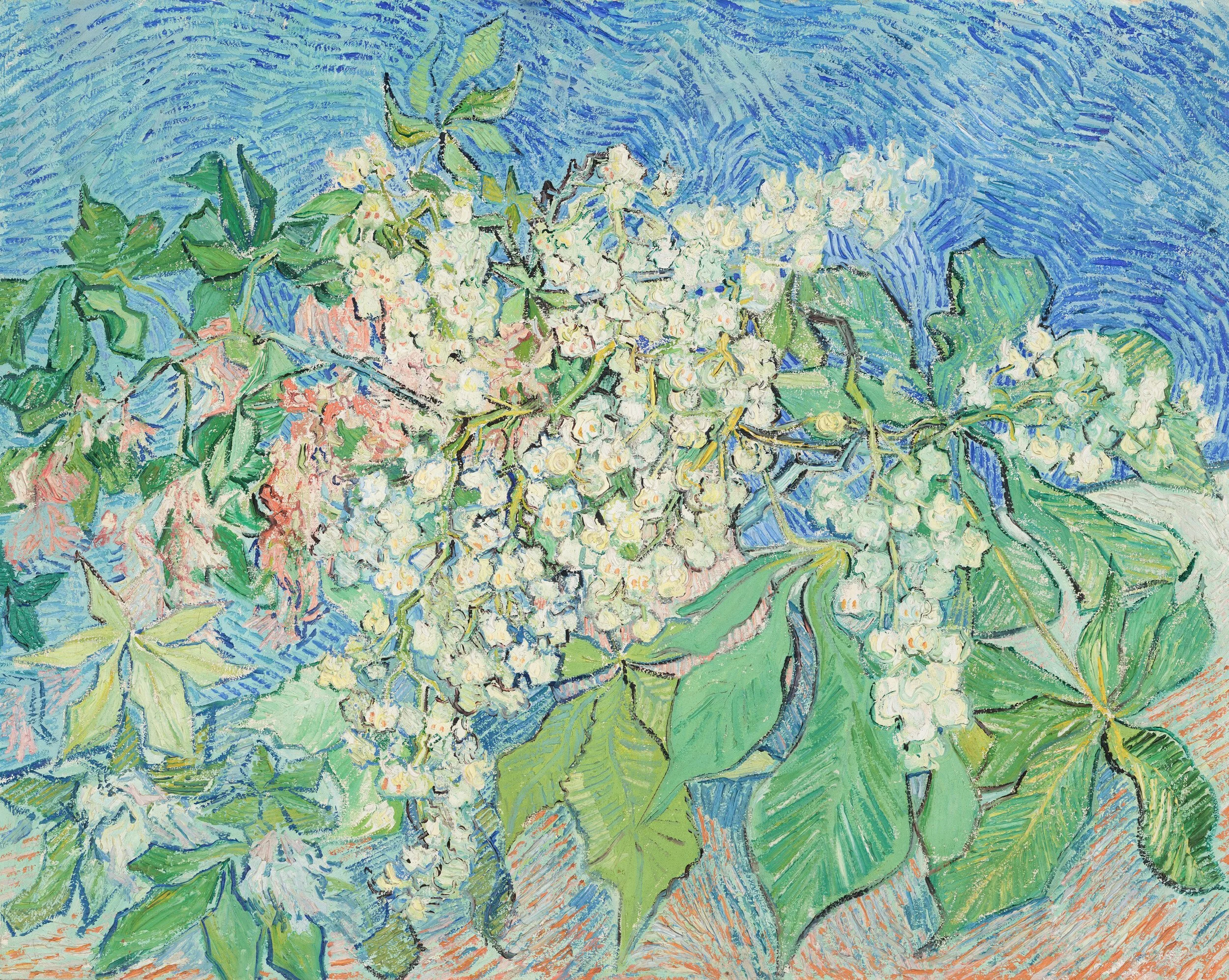
“Blossoming Chestnut Branches” — Vincent van Gogh
“Blossoming Chestnut Branches” presents a cut branch of spring blossom against a vivid blue background, turning a simple motif into an image of freshness, movement, and intensity. Rather than placing the flowers within a deeper setting, van Gogh brings them close to the surface, where petals, leaves, and branching forms seem to press directly against the sky-like field behind them.
The composition spreads diagonally across the canvas, with the chestnut branch extending outward in a loose pattern. White blossoms and broad green leaves stand out sharply against the blue background, while the surface is energized by visible strokes that keep the image in motion.
Van Gogh painted flowering branches repeatedly, especially in moments when spring and renewal held strong emotional meaning for him. In his later work, subjects like blossoming branches became a way to unite direct observation with expressive color and line. Here, his bold outlines and heightened contrasts show how deeply he had absorbed Japanese printmaking while still making the image unmistakably his own.
Expressed on silk and paired with integrated illumination, the artwork takes on a different presence from traditional surfaces. The translucency of silk allows light to pass through the image, introducing a sense of depth and softness that changes with its surroundings. Rather than remaining a fixed image, the piece responds to light and its environment, shifting in presence throughout the day. Appearing quiet and refined in natural light, it becomes softly luminous as light grows more prominent.
“Blossoming Chestnut Branches” — Vincent van Gogh
“Blossoming Chestnut Branches” presents a cut branch of spring blossom against a vivid blue background, turning a simple motif into an image of freshness, movement, and intensity. Rather than placing the flowers within a deeper setting, van Gogh brings them close to the surface, where petals, leaves, and branching forms seem to press directly against the sky-like field behind them.
The composition spreads diagonally across the canvas, with the chestnut branch extending outward in a loose pattern. White blossoms and broad green leaves stand out sharply against the blue background, while the surface is energized by visible strokes that keep the image in motion.
Van Gogh painted flowering branches repeatedly, especially in moments when spring and renewal held strong emotional meaning for him. In his later work, subjects like blossoming branches became a way to unite direct observation with expressive color and line. Here, his bold outlines and heightened contrasts show how deeply he had absorbed Japanese printmaking while still making the image unmistakably his own.
Expressed on silk and paired with integrated illumination, the artwork takes on a different presence from traditional surfaces. The translucency of silk allows light to pass through the image, introducing a sense of depth and softness that changes with its surroundings. Rather than remaining a fixed image, the piece responds to light and its environment, shifting in presence throughout the day. Appearing quiet and refined in natural light, it becomes softly luminous as light grows more prominent.