 Image 1 of 1
“Approach to Venice” — Joseph Mallord William Turner
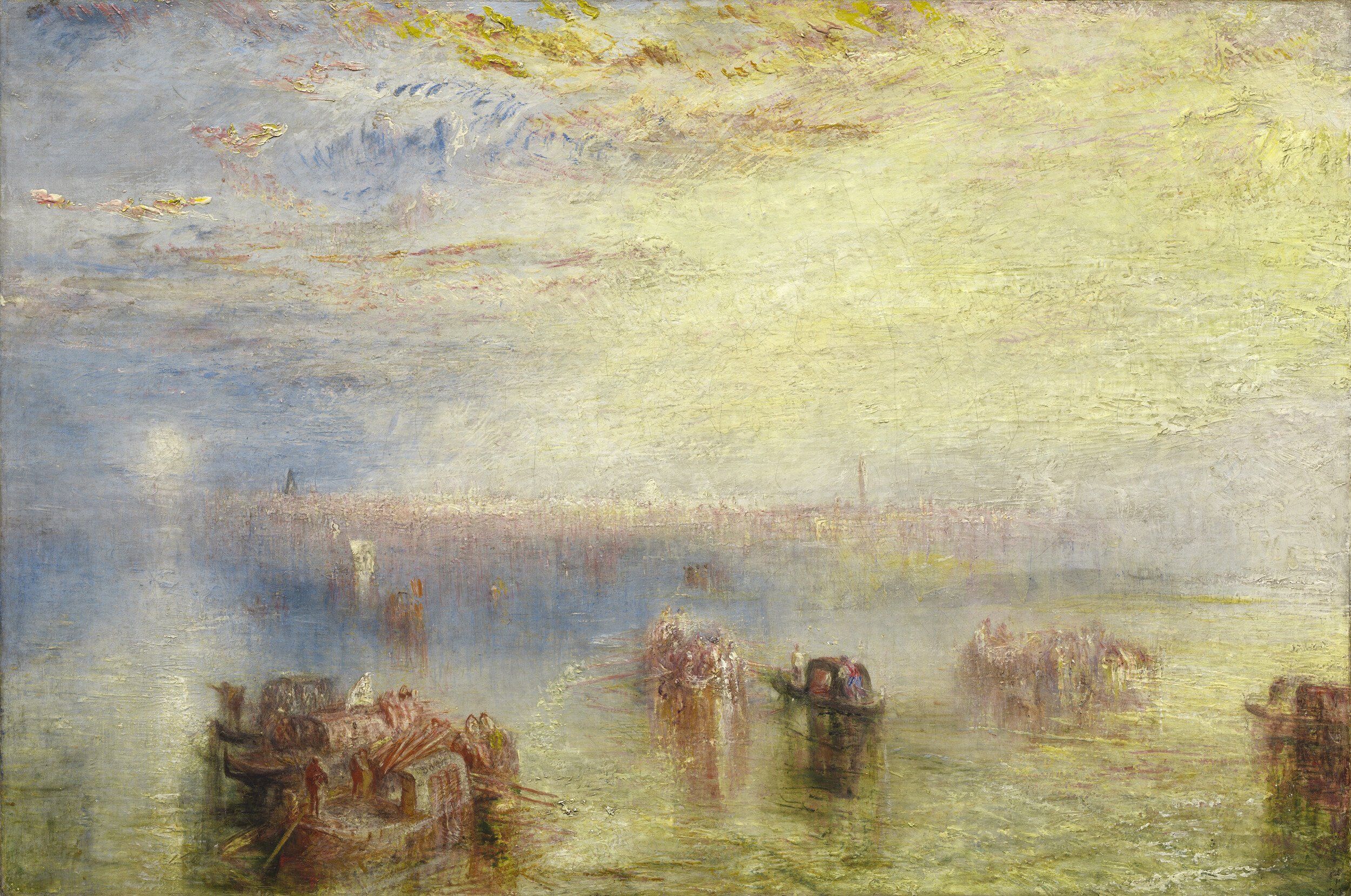
When Turner first exhibited “Approach to Venice” in 1844, he paired it with lines from the English poet Byron describing a moment suspended between moonrise and sunset. That tension remains at the heart of the painting. The lagoon is filled with barges and smaller vessels, while light spreads across the water in a way that feels both radiant and dreamlike.
The scene opens across broad water toward the distant city, but Turner keeps the forms soft and atmospheric rather than sharply defined. Boats move across the lagoon, and the horizon dissolves into luminous color. The composition is spacious, but never empty. Instead, it feels suspended between movement and stillness, day and night, arrival and distance.
In his depictions of Venice, architecture and water often recede into atmosphere, allowing light itself to become the true center of the image.
Expressed on silk and paired with integrated illumination, the artwork takes on a different presence from traditional surfaces. The translucency of silk allows light to pass through the image, introducing a sense of depth and softness that changes with its surroundings. Rather than remaining a fixed image, the piece responds to light and its environment, shifting in presence throughout the day. Appearing quiet and refined in natural light, it becomes softly luminous as light grows more prominent.
“Approach to Venice” — Joseph Mallord William Turner
When Turner first exhibited “Approach to Venice” in 1844, he paired it with lines from the English poet Byron describing a moment suspended between moonrise and sunset. That tension remains at the heart of the painting. The lagoon is filled with barges and smaller vessels, while light spreads across the water in a way that feels both radiant and dreamlike.
The scene opens across broad water toward the distant city, but Turner keeps the forms soft and atmospheric rather than sharply defined. Boats move across the lagoon, and the horizon dissolves into luminous color. The composition is spacious, but never empty. Instead, it feels suspended between movement and stillness, day and night, arrival and distance.
In his depictions of Venice, architecture and water often recede into atmosphere, allowing light itself to become the true center of the image.
Expressed on silk and paired with integrated illumination, the artwork takes on a different presence from traditional surfaces. The translucency of silk allows light to pass through the image, introducing a sense of depth and softness that changes with its surroundings. Rather than remaining a fixed image, the piece responds to light and its environment, shifting in presence throughout the day. Appearing quiet and refined in natural light, it becomes softly luminous as light grows more prominent.