 Image 1 of 1
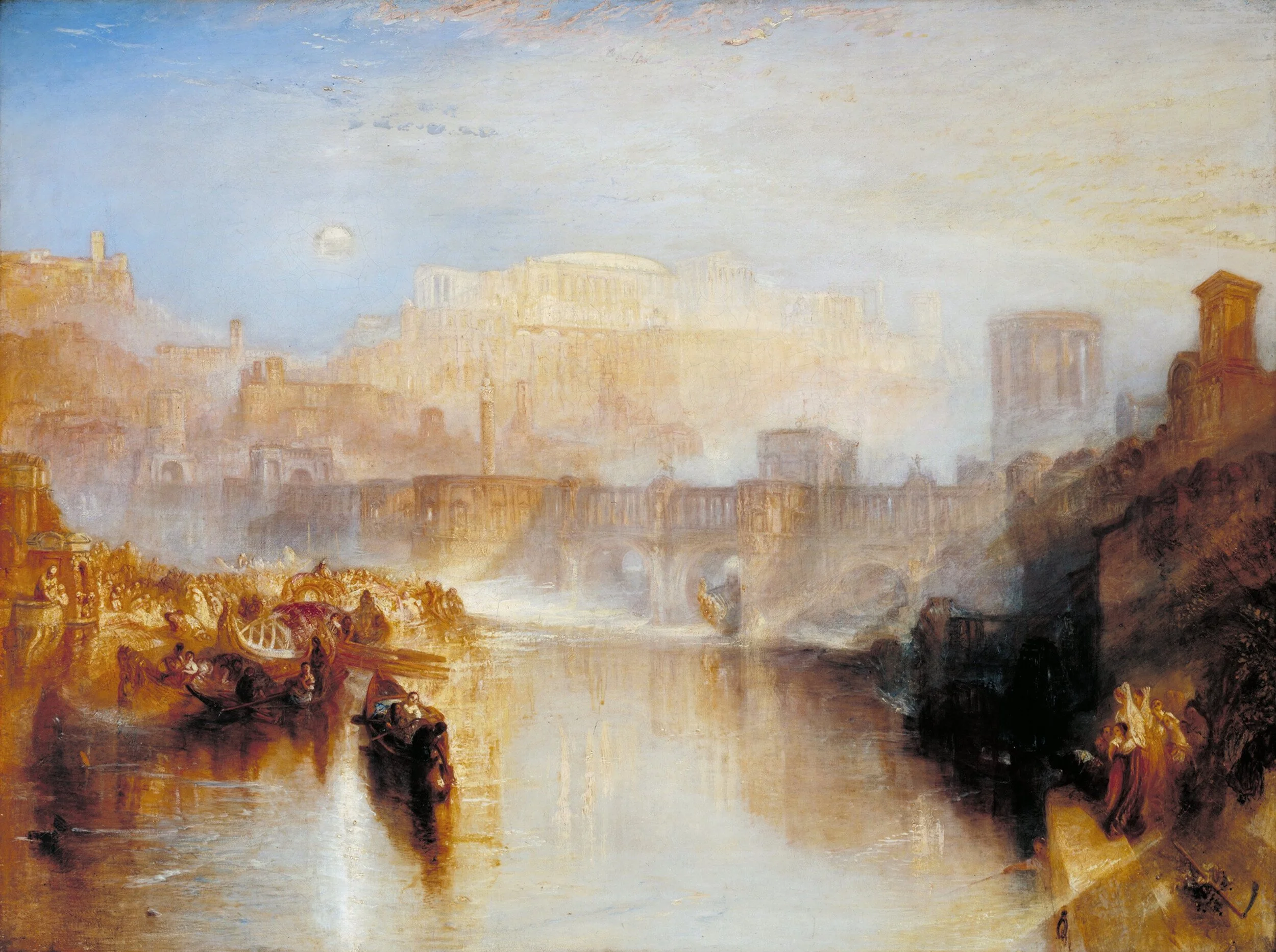
“Ancient Rome: Agrippina Landing with the Ashes of Germanicus” — Joseph Mallord William Turner
“Ancient Rome: Agrippina Landing with the Ashes of Germanicus” transforms a scene of mourning into a vast vision of empire, memory, and light. Rather than centering the painting on a single dramatic action, Turner expands the subject into a glowing cityscape where architecture, water, and atmosphere suggest both the grandeur and fragility of empire.
The composition opens across a broad river, with boats, figures, and ceremonial movement unfolding beneath a luminous ancient city. The scene is crowded with incident, but the larger effect is atmospheric rather than narrative. Buildings rise through mist and light, while the water below reflects the entire spectacle in softened golds and pale blues. The result feels both monumental and unstable, as though history itself is being seen through light and distance.
J. M. W. Turner was celebrated for expressive color, imaginative landscapes, and his ability to make light itself the emotional center of a painting. In works like this, he fuses historical subject matter with atmosphere, creating scenes that feel both grand and deeply reflective.
Expressed on silk and paired with integrated illumination, the artwork takes on a different presence from traditional surfaces. The translucency of silk allows light to pass through the image, introducing a sense of depth and softness that changes with its surroundings. Rather than remaining a fixed image, the piece responds to light and its environment, shifting in presence throughout the day. Appearing quiet and refined in natural light, it becomes softly luminous as light grows more prominent.
“Ancient Rome: Agrippina Landing with the Ashes of Germanicus” — Joseph Mallord William Turner
“Ancient Rome: Agrippina Landing with the Ashes of Germanicus” transforms a scene of mourning into a vast vision of empire, memory, and light. Rather than centering the painting on a single dramatic action, Turner expands the subject into a glowing cityscape where architecture, water, and atmosphere suggest both the grandeur and fragility of empire.
The composition opens across a broad river, with boats, figures, and ceremonial movement unfolding beneath a luminous ancient city. The scene is crowded with incident, but the larger effect is atmospheric rather than narrative. Buildings rise through mist and light, while the water below reflects the entire spectacle in softened golds and pale blues. The result feels both monumental and unstable, as though history itself is being seen through light and distance.
J. M. W. Turner was celebrated for expressive color, imaginative landscapes, and his ability to make light itself the emotional center of a painting. In works like this, he fuses historical subject matter with atmosphere, creating scenes that feel both grand and deeply reflective.
Expressed on silk and paired with integrated illumination, the artwork takes on a different presence from traditional surfaces. The translucency of silk allows light to pass through the image, introducing a sense of depth and softness that changes with its surroundings. Rather than remaining a fixed image, the piece responds to light and its environment, shifting in presence throughout the day. Appearing quiet and refined in natural light, it becomes softly luminous as light grows more prominent.