 Image 1 of 1
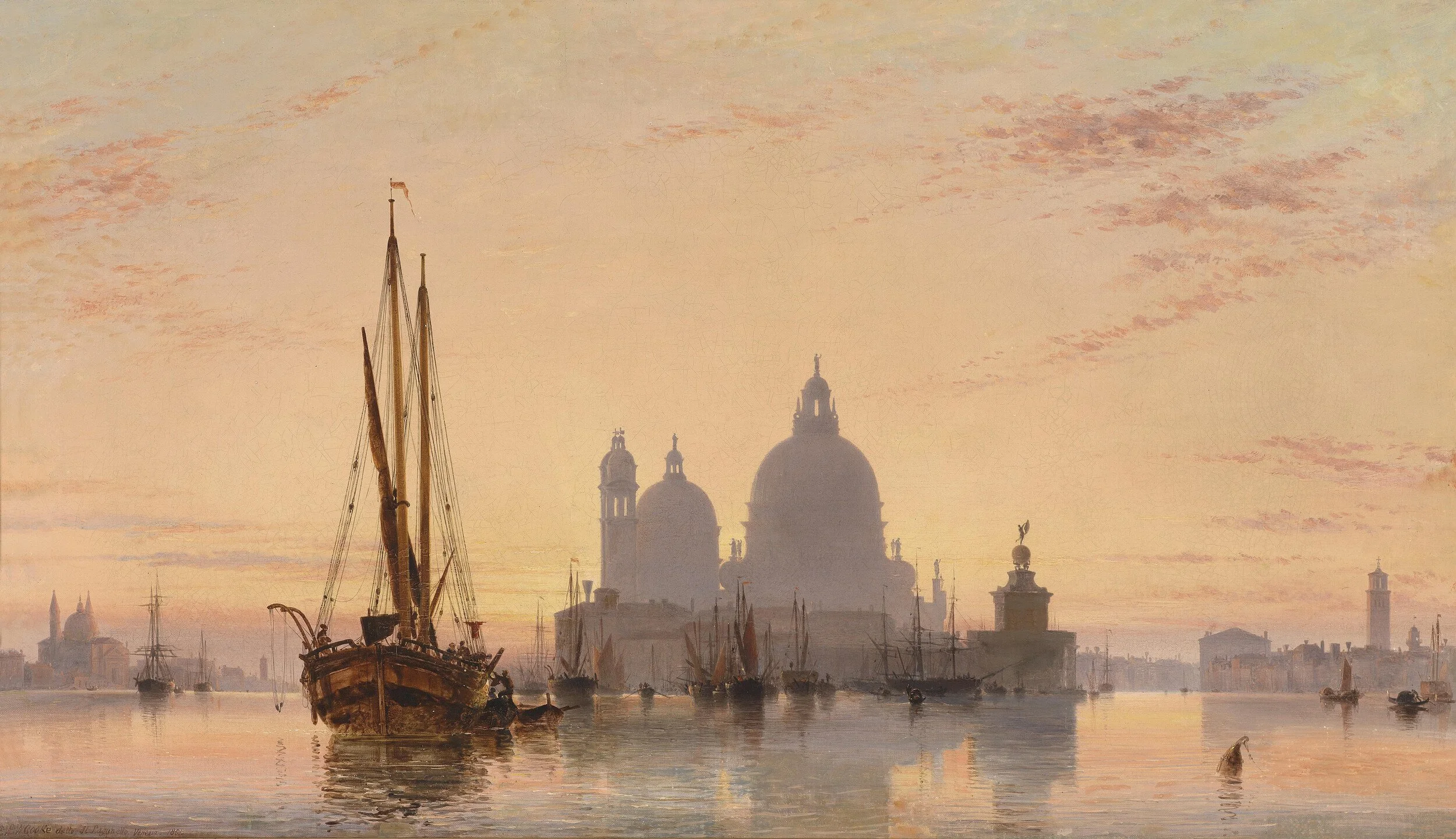
“A Venetian View with Santa Maria della Salute” — Edward William Cooke
“A Venetian View with Santa Maria della Salute” captures Venice through still water, anchored boats, and the soft silhouette of one of the city’s most recognizable churches. Rather than focusing on movement or crowding, the painting holds the scene in a moment of quiet light, where reflections and distant architecture create a calm, luminous atmosphere.
The foreground is shaped by boats resting on the water, while the domes and towers of Venice rise in the distance against a glowing sky. The composition depends on restraint: broad water, quiet reflections, and a skyline softened by haze. That stillness gives the architecture a monumental presence without making the scene feel rigid.
Edward William Cooke was an English painter known especially for marine and landscape painting. He was admired for his handling of ships, coastal views, and atmospheric settings, which makes a Venetian subject like this especially characteristic of his work.
Expressed on silk and paired with integrated illumination, the artwork takes on a different presence from traditional surfaces. The translucency of silk allows light to pass through the image, introducing a sense of depth and softness that changes with its surroundings. Rather than remaining a fixed image, the piece responds to light and its environment, shifting in presence throughout the day. Appearing quiet and refined in natural light, it becomes softly luminous as light grows more prominent.
“A Venetian View with Santa Maria della Salute” — Edward William Cooke
“A Venetian View with Santa Maria della Salute” captures Venice through still water, anchored boats, and the soft silhouette of one of the city’s most recognizable churches. Rather than focusing on movement or crowding, the painting holds the scene in a moment of quiet light, where reflections and distant architecture create a calm, luminous atmosphere.
The foreground is shaped by boats resting on the water, while the domes and towers of Venice rise in the distance against a glowing sky. The composition depends on restraint: broad water, quiet reflections, and a skyline softened by haze. That stillness gives the architecture a monumental presence without making the scene feel rigid.
Edward William Cooke was an English painter known especially for marine and landscape painting. He was admired for his handling of ships, coastal views, and atmospheric settings, which makes a Venetian subject like this especially characteristic of his work.
Expressed on silk and paired with integrated illumination, the artwork takes on a different presence from traditional surfaces. The translucency of silk allows light to pass through the image, introducing a sense of depth and softness that changes with its surroundings. Rather than remaining a fixed image, the piece responds to light and its environment, shifting in presence throughout the day. Appearing quiet and refined in natural light, it becomes softly luminous as light grows more prominent.